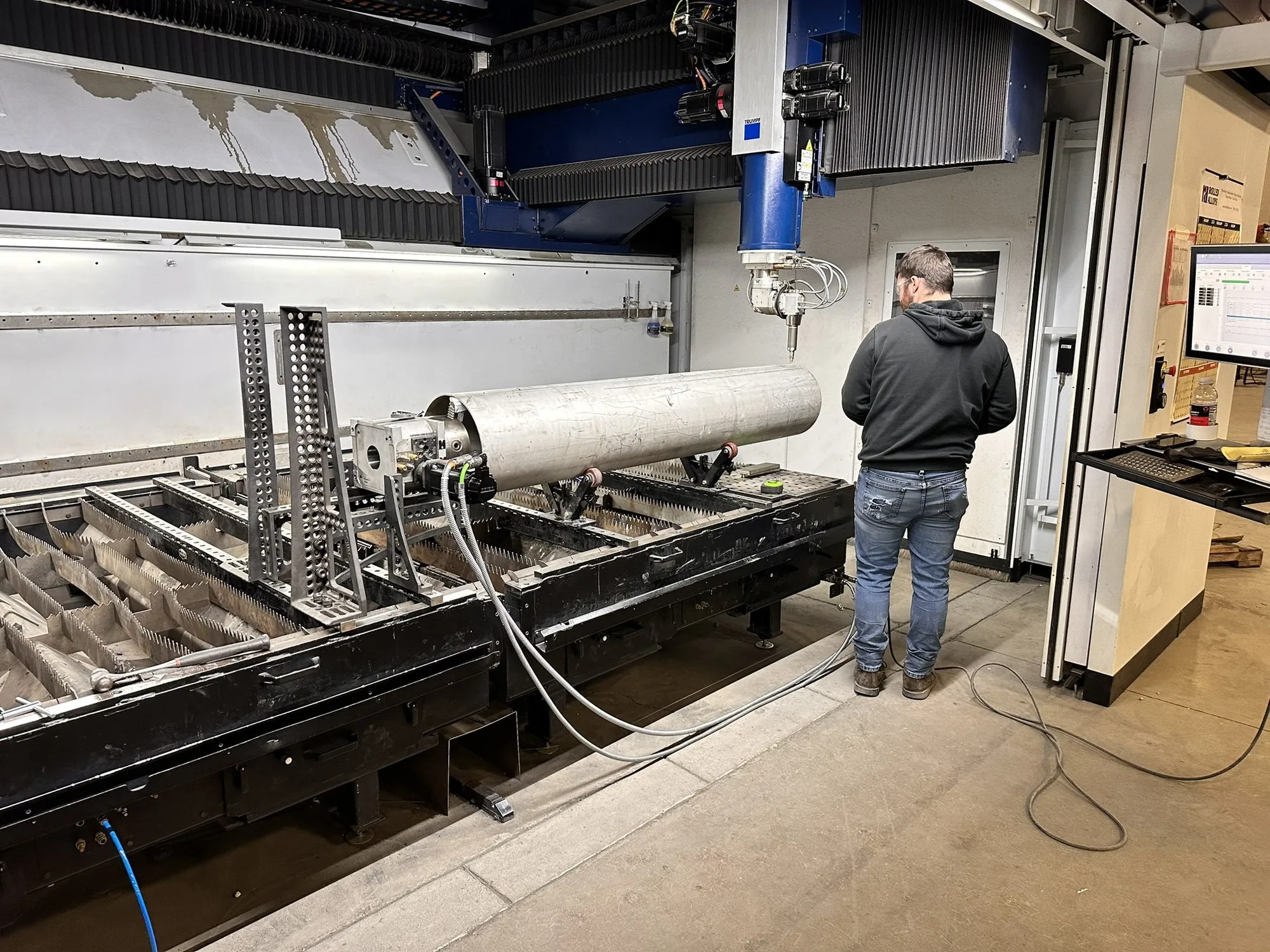
Northern Manufacturing runs a Prima Optimo 5-axis laser cutting cell at our Oak Harbor, Ohio facility: a 150 by 80 inch work envelope, cut accuracy to 0.005 inch, stainless and carbon steel to 1/2 inch thick, aluminum to 1/4 inch. The cutting head tilts and rotates around the part, which puts formed shapes, rolled shells, and finished weldments inside cutting range, not just flat sheet.
ISO 9001:2015 certified by AVU Registrations (IAS-accredited, certificate #00157-4). Standard weldment tolerances run to ISO 13920-BF, precision weldments to ISO 13920-AE. The 5-axis cell shares the laser bay with two flat lasers (Trumpf TruLaser 3060, Trumpf TruLaser 5040 Fiber) and a Trumpf TruLaser Tube 7000 tube laser, with cutting programs written directly from customer CAD.
Cut Features After Welding, Not Before
Welding shrinks material. Every pass pulls the surrounding metal toward the joint, and on a large stainless assembly the accumulated shrinkage adds up to real movement: hole patterns drift, port centerlines walk, mounting features end up somewhere near where the flat-pattern blank put them. Cut those features before welding and the drawing tolerance has to absorb fabrication it was never budgeted for.
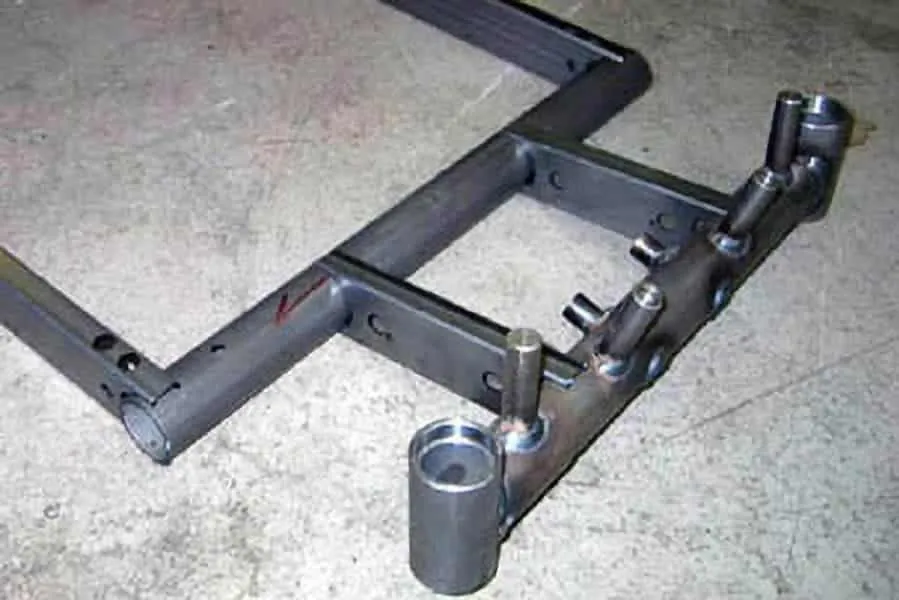
A standard tolerance block puts three-place decimal features at plus or minus 0.005 inch. On a flat blank that is routine work. On a welded assembly it is only achievable if the feature is cut after the welding is done, referenced to the part as it actually exists. That is the job the 5-axis laser was bought for: the assembly comes off the weld floor complete, gets fixtured once, and the laser cuts bolt holes, ports, and trim lines into the finished geometry at 0.005 inch.
Cut features are verified against the model before the part leaves the cell. For critical-service assemblies, dimensional inspection escalates to 3D scanning and Leica AT960 laser tracker measurement, with records we can provide in the quality package when your purchase order calls for it.
We have run this sequence on a welded austenitic stainless assembly where a pattern of openings had to hold a tight angular alignment after welding. Weld shrinkage and distortion are predictable, so instead of fighting them we sequence the work around them. The assembly is welded first, with the weld procedure qualified to ASME BPVC Section IX, and the part is allowed to settle into the shape welding leaves it in. Only then do we cut the openings on the 5-axis laser, into the geometry the part actually holds once it has stabilized, so each opening finishes where the drawing needs it. Cut those openings before welding instead and the shrinkage walks them out of alignment, which is exactly the failure a low-bid sequence invites on this kind of part.
Geometry a Flat Bed Cannot Reach
A flat-bed laser stops being useful the moment the part stops being flat. The 5-axis head keeps cutting:
- Profiles on diameters past 10 inches. Saddles, copes, nozzle penetrations, and end trims on rolled shells and large ductwork, beyond tube-laser range.
- Angled and beveled edges for weld prep. Compound bevels cut to a consistent land, replacing hand grinding on full-penetration joint prep.
- Cutouts on formed parts and welded assemblies. Openings cut through press-brake forms, deep-drawn shapes, and completed weldments without flattening anything.
- Trim operations on formed parts. Edge trims on deep-drawn and press-brake parts where the trim line follows the formed contour.
One Bay, Three Laser Systems
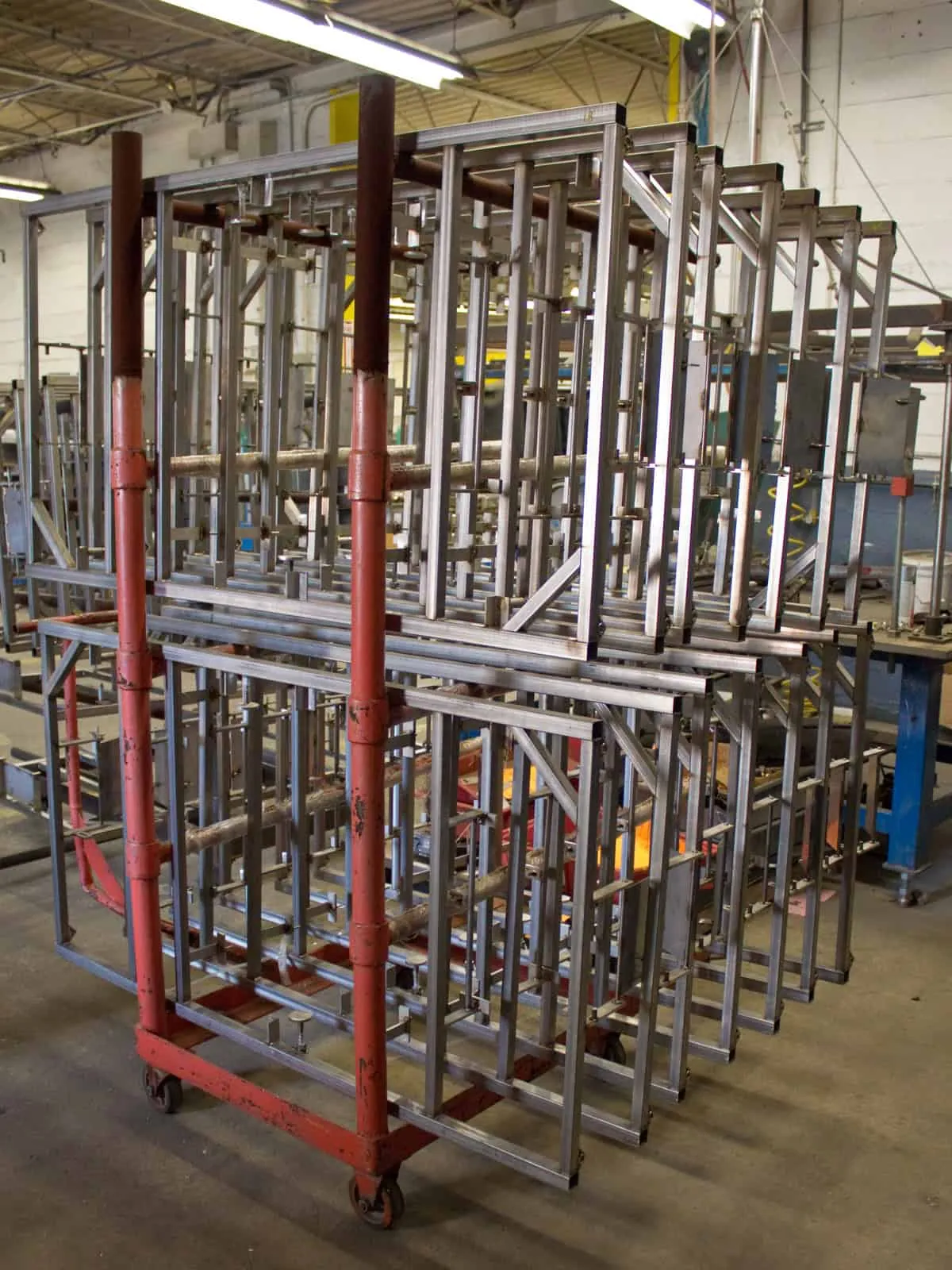
Most parts cross more than one machine. A blank nests on the flat laser, forms on a press brake, welds in a fixture, and comes back to the 5-axis cell for final features. The routing happens inside one building, under one quality system.
| System | Geometry | Where it fits |
|---|---|---|
| Flat laser cutting (TruLaser 3060, 5040 Fiber) | Flat sheet and plate | Nested blanks cut before forming; stainless to 1.25 in on the fiber laser |
| Tube laser cutting (TruLaser Tube 7000) | Straight tube, pipe, and structural profiles | Prepped weld ends, miters, and alignment tabs on tube and structural stock |
| 3D laser cutting (Prima Optimo) | Formed parts, welded assemblies, compound angles | Post-weld features, weld-prep bevels, diameters past 10 in, trim on formed shapes |
The same CAD model drives all three. Programs come straight from your SolidWorks or STEP files, so the slot-and-tab features that locate parts in your fixtures match the model that generated them.
Replace Drilling and Milling on Large Components
Putting a 12-foot weldment on a machining center means heavy fixturing, long setups, and a machine occupied by work that uses a fraction of its capability. For hole patterns, openings, and edge trims with tolerances the laser holds, 5-axis cutting does the same work in one setup at 0.005 inch accuracy. Features the laser cannot replace (threaded bores, machined seal faces, tight-fit bearing seats) stay with machining, and the split gets scoped during quote review so you are not paying machining rates for laser work.
That changes how parts get designed and built. Features that were drilled in place during field assembly can ship pre-cut. Features that forced a weldment onto a boring mill can move to the laser. And stainless steel welding sequences that were constrained by pre-cut hole positions can run in whatever order makes the best weld, because the critical features go in last.