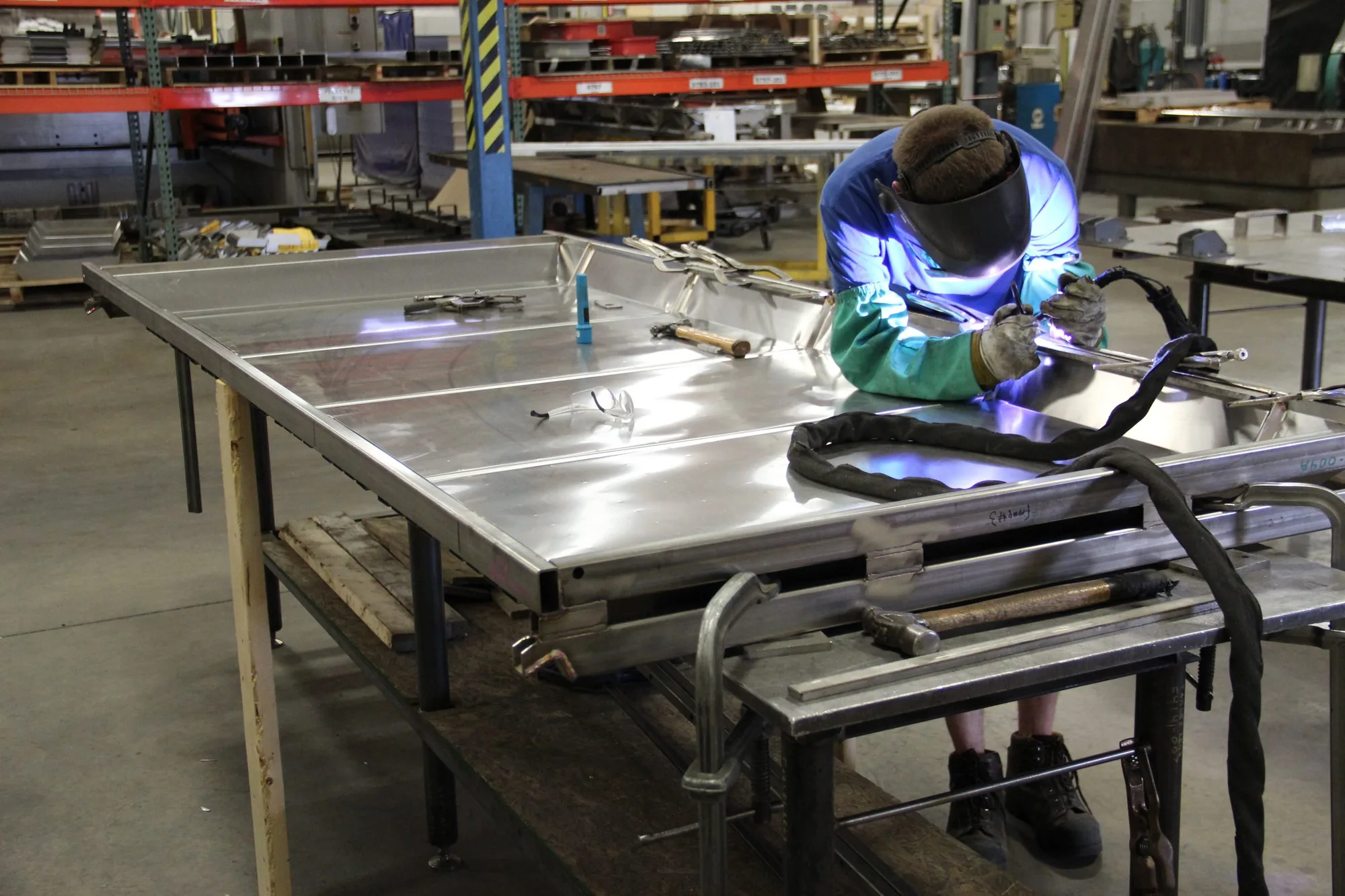
Northern Manufacturing runs a weld department built around stainless and specialty alloys. 78 welding bays, 60+ AWS-certified welders, and a skeleton second shift of 7. Every stainless weld runs inside our 40,000 sq ft stainless-only production space in Oak Harbor, Ohio, where dedicated tooling, consumables, and welders keep free iron off corrosion-critical assemblies. Carbon and aluminum work runs in separate bays.
ISO 9001:2015 certified (AVU Registrations, certificate #00157-4). ASME BPVC Section IX qualified welding procedures across P1, P7, P8, P10H, P43, and P45, plus qualified dissimilar-metal combinations for clad piping and transition spools. AWS Certified Welding Inspector (CWI) on staff.
Code Qualifications
Welding procedures and welders are qualified to the codes most common on stainless fabrication drawings. Current WPS/PQR packages and welder continuity logs are on file in our Quality Department and available on request during the bid process.
| Code | Scope | NMC qualification |
|---|---|---|
| AWS D1.6 | Structural Welding, Stainless Steel | Primary code for stainless fabrication |
| AWS D1.1 | Structural Welding, Steel | Qualified welders on staff |
| AWS D1.2 | Structural Welding, Aluminum | Qualified welders on staff |
| AWS D1.3 | Structural Welding, Sheet Steel | WPS on file in Quality |
| AWS D9.1 | Sheet Metal Welding, Non-Structural | WPS on file |
| AWS D17.2 | Resistance Welding, Aerospace | MySpot spot welder qualified |
| ASME BPVC Section IX | Welding and Brazing Qualifications | 2025 edition, full WPS/PQR file on Section IX code |
| ASME B31.3-2014 | Process Piping | Standard on file |
| API 650 (12th edition) | Welded Tanks for Oil Storage | Standard on file |
ASME Section IX P-Numbers
Section IX groups base materials by P-number so one procedure qualification covers a family of alloys. Northern holds qualified procedures across the families that show up on stainless and specialty fabrication:
| P-number | Materials |
|---|---|
| P1 | Carbon steel (A36, A516) |
| P7 | High-strength low-alloy |
| P8 | Austenitic stainless (304, 316, 309, 321) |
| P10H | Duplex stainless (2205, 2507) |
| P23 | Specific nickel alloys |
| P43 | Inconel, Hastelloy C-276, Hastelloy C-22 |
| P45 | AL-6XN, Alloy 31 |
Qualified dissimilar-metal combinations: P8 to P10H (stainless to duplex), P8 to P43 (stainless to Inconel or Hastelloy), P8 to P45 (stainless to AL-6XN), and P43 to P45 (Inconel to AL-6XN). These combinations show up on clad piping, transition spools, and vessel internals where two alloys meet.
Northern holds the ASME U stamp (Certificate of Authorization #63199, manufacture of pressure vessels) and the ASME PP stamp (Certificate #63198, fabrication and assembly of pressure piping), both authorized May 2026 at the Oak Harbor shop. Code vessels and pressure piping are welded under the same Section IX procedures. Both certificates are shop-location-only, so field code fabrication is out of scope, and we do not hold the R stamp for code repairs or the S stamp for power boilers.
Material-Specific Welding Strategy
The failure mode changes with the alloy. Procedures that produce sound welds on 304L will crack duplex, destroy Hastelloy, or sensitize 316L in the heat-affected zone. Production welding on each family runs under procedures tuned to the metallurgy:
| Alloy family | Failure mode we control | How production welding runs |
|---|---|---|
| Austenitic stainless (304, 316, 309, 321) | Sensitization in the heat-affected zone | Heat input held below the sensitization range. “L” grades (304L, 316L) tolerate heavier sections without re-solution-annealing. Sanitary service gets full-penetration GTAW with autogenous or matching filler for crevice-free interior joints. |
| Duplex (2205, 2507) | Sigma-phase embrittlement, ferrite imbalance | Interpass temperature capped on the WPS. Matching filler specified (ER2209 for 2205, ER2594 for 2507). Ferrite measured on production weldments, not just coupons. |
| Hastelloy (C-276, C-22) and Inconel | Hot cracking and microsegregation in the weld metal | Low-heat-input GTAW with tight bead-width control and matching filler (ERNiCrMo-4 for C-276, ERNiCrMo-10 for C-22). |
| AL-6XN (P45) | Molybdenum segregation in the fusion zone | Overmatching filler (ERNiCrMo-3) preserves corrosion resistance where the base metal would fall short. |
| Carbon (P1) and HSLA (P7) | Free-iron transfer onto stainless work | Welded under AWS D1.1 and Section IX for structural and pressure-boundary work, in separate bays from stainless. |
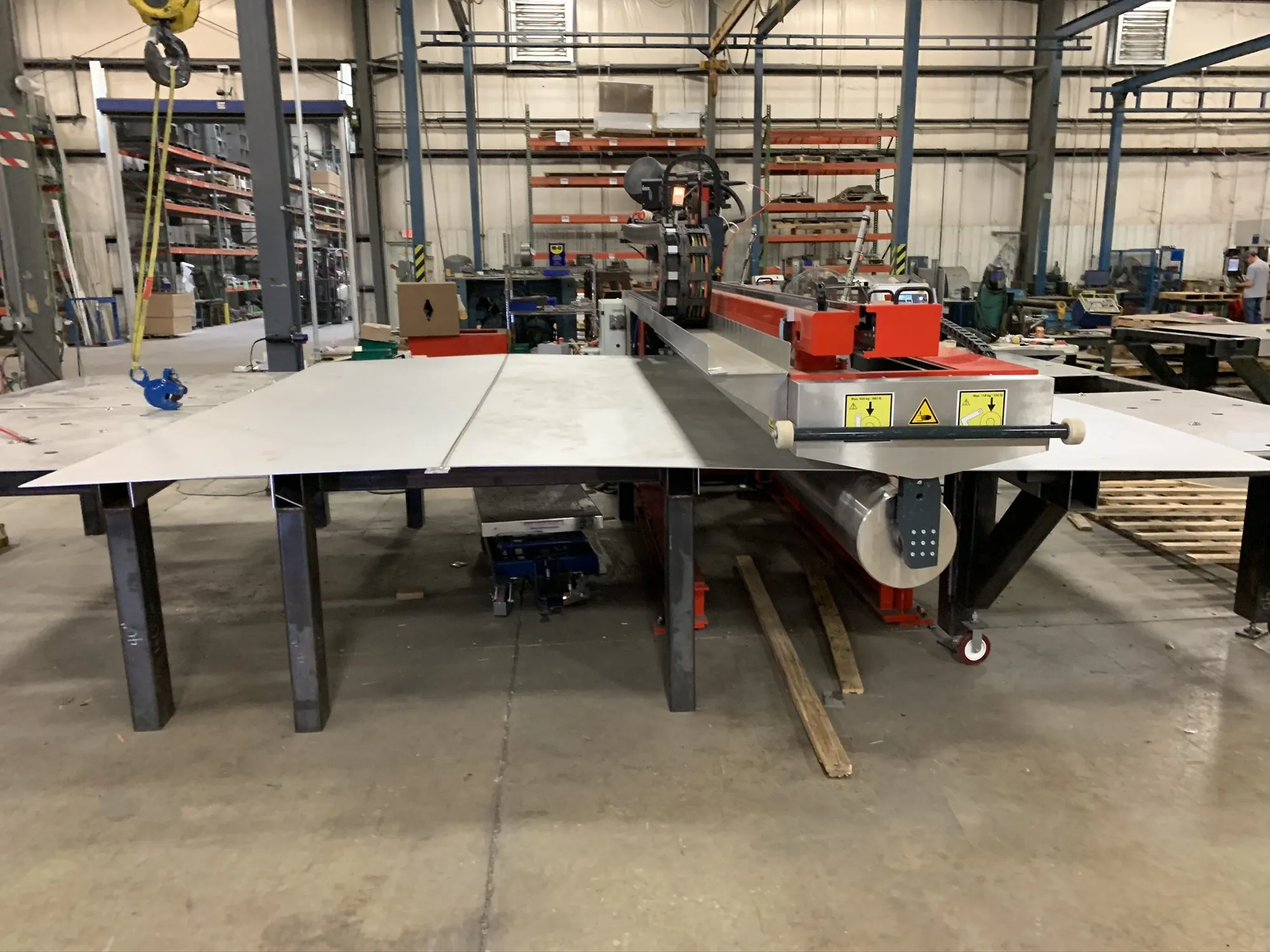
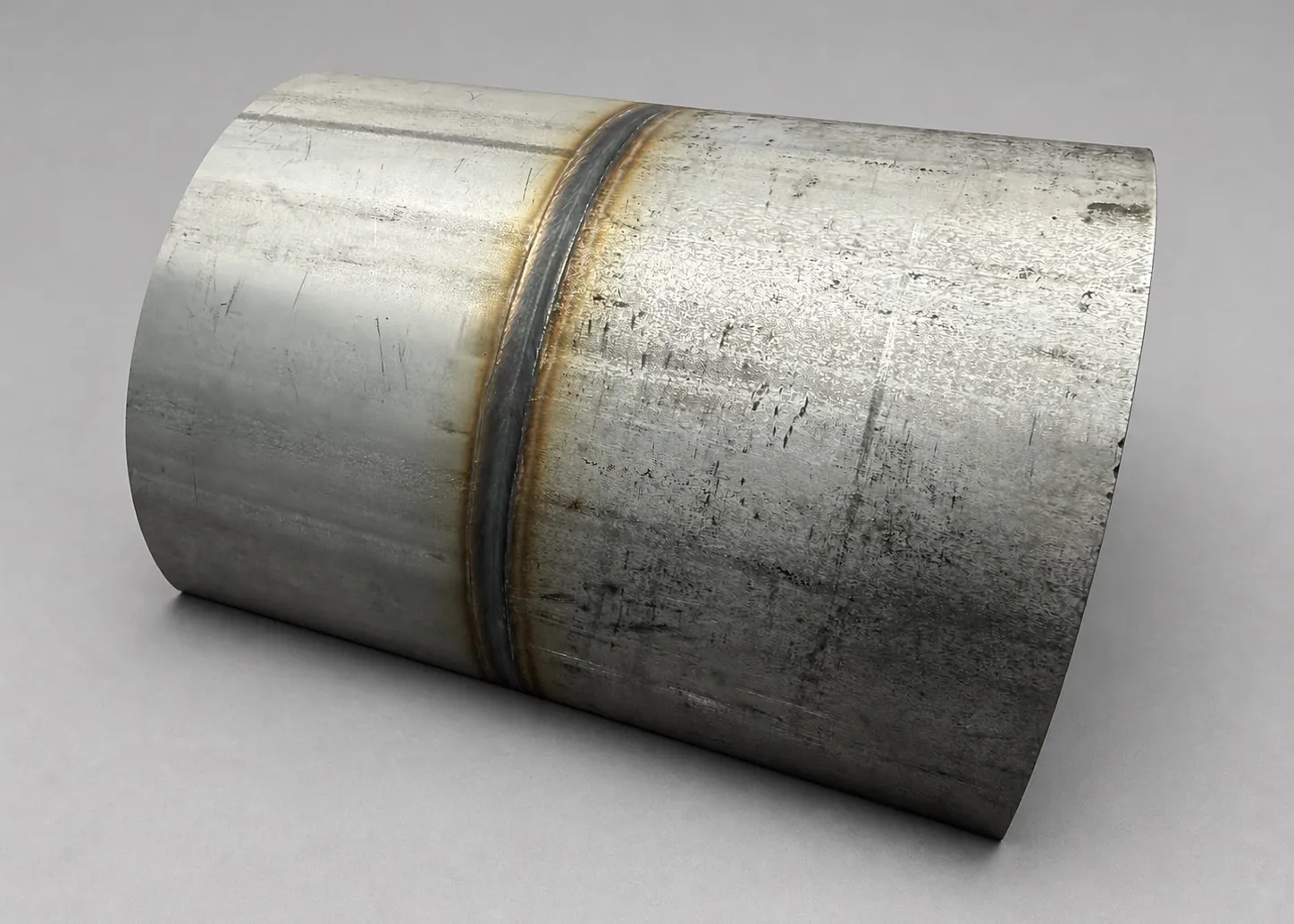
Austenitic stainless punishes excess heat, so on thin and heat-sensitive 304 and 316L work we match the process to the part. Where an arc weld would distort thin formed sheet, laser welding makes a sealed, low-stress seam that holds the formed shape, and on heavier plate it reaches full penetration on a square edge without the bevel and multiple passes an arc joint needs. Less weld volume means less shrinkage and less prep. Every procedure is qualified to ASME BPVC Section IX before it runs.
Heat Input, Distortion, and Integrity
Welding is the place where specifications meet metallurgy and usually meet trouble. Three controls define whether a weld survives service or becomes the next warranty claim.
Heat input. Measured in kJ/inch and logged against the WPS. Excessive heat causes sensitization on 304, sigma-phase formation on duplex, hot cracking on nickel alloys, and distortion on thin-gauge stainless. Interpass temperature is monitored continuously on multi-pass welds.
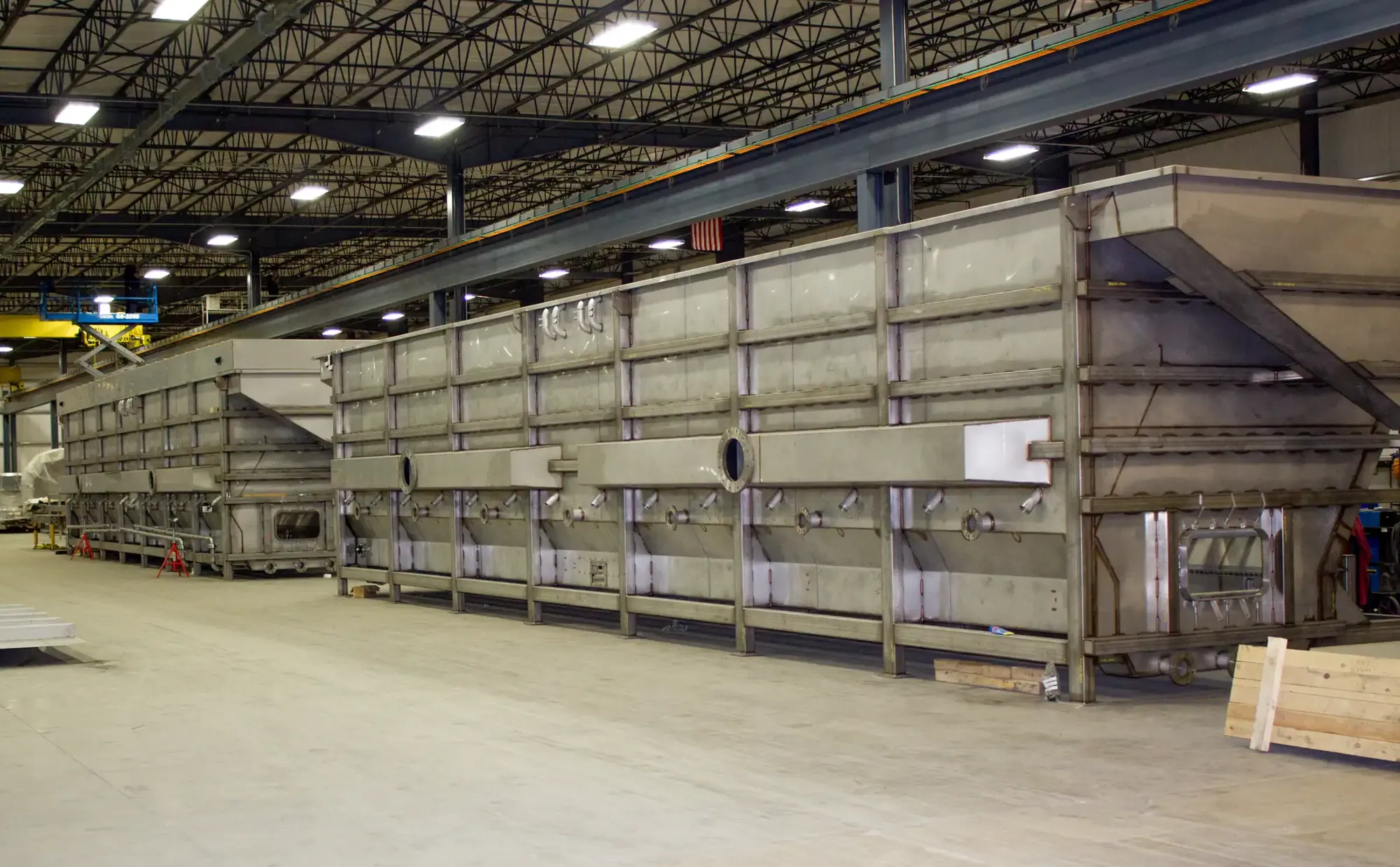
Distortion control. Long seams on stainless cylinders and troughs want to bow. We hold straightness through laser-aligned sectional fit-up, controlled sequence welding, and custom fixturing engineered for the part geometry. One of our longer stainless troughs, 100 feet end-to-end in 304L, held straight within 1/8 inch across the full span.
Distortion control is not only about limiting heat. On structural stainless members welded under AWS D1.6, the shrink from web-to-flange welds is predictable, so we plan for it and bring the member to straight rather than grinding it true afterward, then check the finished geometry against the model with laser tracking.
Weld integrity. NDE is specified per the drawing: visual (VT) to AWS D1.6 acceptance criteria, dye penetrant (PT) on root passes, and ultrasonic (UT) where geometry rules out radiography, all run in-house. Radiography (RT) on full-penetration joints is coordinated through a qualified NDE partner. Ferrite content and PMI (positive material identification) are available on request. One cosmetic condition most specs never address: silica islands on stainless welds, a normal GMAW byproduct that AWS D1.6 does not list as rejectable. Call out their acceptance in the spec before inspection, not at the receiving dock.
Finishing handoff. Welding leaves heat tint and a chromium-depleted layer that strip corrosion resistance in service. On corrosion-critical work, in-house pickling and passivation per ASTM A380 and A967 in the 55-foot booth restore the passive layer along every weld before the assembly ships.
Documentation for Your Weld Package
We can provide the documentation a quality audit or code review will ask for, when your purchase order calls for it:
- Material Test Reports (MTRs) traced by heat number from mill cert through final weldment
- Weld maps identifying every joint, its WPS reference, and the welder stamp
- Welder continuity logs confirming active qualification at the time of fabrication
- WPS and PQR packages on file per ASME Section IX or the AWS code called out
- NDE reports (VT, PT, MT, RT, UT as specified)
- Ferrite measurement records for duplex welds
- PMI records for specialty-alloy work
- Certificate of Conformance (CoC) to your purchase order requirements