Frequently Asked Questions
Stainless Fabrication, Answered
The questions engineers and buyers ask before sending a drawing: materials, laser cutting, certified welding, quality and quoting. Every answer reflects how the shop actually runs.
Browse by topic
Don't see your question?
Send the spec straight to an engineer. We review the drawing before pricing it.
Request a Quote Or call (419) 898-2821 →Working With Us
5 questionsWhat does "custom stainless steel fabrication" mean at Northern Manufacturing?
We build non-standard parts, weldments and assemblies exactly to your print, no catalogue items, using flat, tube and 5-axis laser cutting, CNC forming, certified welding, and in-house finishing (pickling, passivation, and bead blasting) under one ISO 9001 quality system.
What certifications and qualifications does Northern hold?
ISO 9001:2015 (AVU Registrations, certificate #00157-4); ASME BPVC Section IX qualified welding procedures (P1, P7, P8, P10H, P43, P45); 60+ AWS-certified welders running AWS D1.6 qualified procedures; an AWS Certified Welding Inspector (CWI) on staff; and ASNT SNT-TC-1A Level III NDE in-house. Northern also holds the ASME U stamp (Certificate #63199) and PP stamp (Certificate #63198), authorizing shop manufacture of code pressure vessels and pressure piping to your specification at our Oak Harbor shop, shop location only, no field code work. See our certifications and compliance page.
What does "stainless steel job shop" mean in practice?
We run a high-mix, low-volume workflow: a single prototype pump housing today, a 4,000-piece bracket run tomorrow. Because laser, forming, welding and inspection are in-house, change-overs take minutes, not shifts.
I build a family of parts, never the same part number twice. Is that a problem?
Not at all. Most of our work is family-of-parts for custom systems. We read your updated models, regenerate NC code and treat each release as its own controlled lot for traceability.
What run sizes can Northern handle?
Prototype and R&D Qty 1 to 3, typical project lots Qty 5 to 50, and production contracts up to 10,000 pieces with kanban or JIT call-offs.
Materials & Alloys
5 questionsDo you work exclusively with stainless steel?
Stainless is our core specialty, but not our only metal. Stainless and high-nickel alloys are the large majority of what we process; the balance is carbon-steel or aluminum components bundled into the same PO so customers issue one RFQ and receive one inspection packet from one shop. Think of us as a stainless-focused job shop rather than stainless-only.
What metals and thicknesses can you laser-cut and weld?
From thin gauge sheet to 1 in plate: stainless (304, 316/L, 309, 321, 347, duplex 2205/2507, super-austenitic AL-6XN, and ferritic 409), high-nickel alloys (Hastelloy C-276/C-22, and Inconel 625 with a WPS on file per ASME IX P43), carbon steels (A36, A588, A514, A572) and aluminum (6061-T6, 5052-H32). We fabricate to your specified grade with the heat control, filler, and ferrite or cleanliness checks that alloy needs.
Why choose duplex stainless fabrication over 316L?
Duplex 2205 provides roughly double the yield strength and greater chloride-stress-corrosion resistance, often allowing wall-thickness reductions of 30%. See our duplex vs. 316L guide for the full comparison.
Which non-stainless metals can you include in a project?
Carbon steel (A36, A514, A572, A588), aluminum (6061-T6, 5052-H32) and high-nickel alloys such as Hastelloy C-276/C-22 and Inconel 625.
Do you stock all those alloys?
We stock common 304/L and 316/L sheet and 2205 duplex plate. Exotic grades are bought to order; availability can range from a few days to several weeks depending on the global market.
Laser Cutting & Forming
9 questionsWhat is tube-laser cutting and why choose it over sawing and drilling?
Tube-laser cutting services combine high-power lasers with six-axis motion to pierce holes, copes and miters in one unmanned pass, eliminating secondary drilling and holding plus or minus 0.005 in fit-up accuracy.
What tube sizes can your tube laser handle?
Round, square and rectangular profiles from 3/4 in to 10 in OD, up to 27 ft long.
How accurate are your flat-laser cutting services?
Our flat-laser cutting on the Trumpf TruLaser 3060 holds plus or minus 0.004 in positional tolerance with 0.0012 in repeatability, and the TruLaser 5040 fiber holds plus or minus 0.005 in positional, on sheets up to 80 x 160 in.
Can you etch part numbers or bend lines?
Yes. Micro-etching of text, QR codes or bend reliefs adds zero setup time or cost.
What parts benefit from 5-axis laser cutting?
Welded shells or frames that move during welding: we weld first, let natural shrinkage occur, then 5-axis-cut final holes and slots so critical features hold machining-level tolerances.
How thick can you 5-axis cut in stainless?
Up to 0.375 in (9.5 mm) stainless with bevel angles to 45 degrees.
What is CNC press-brake forming?
Our CNC bending and forming services use computer-controlled press brakes with programmable tooling for repeatable bends; on-board angle measurement eliminates trial-and-error.
What is your maximum bend length and tonnage?
Our press-brake lineup is five Trumpf TruBend brakes (5320 x2, 5085S, 5230) plus a large Ermak CNC press brake for the longest and heaviest stainless components. We confirm the exact bend length and thickness per part at quote review.
What cylinder-rolling services do you offer?
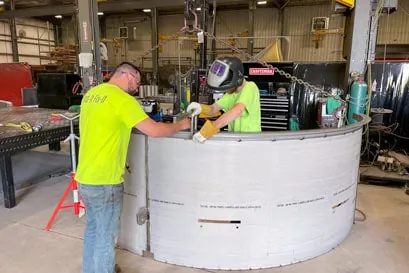
We roll stainless and carbon cylinders from 8 in to 120 in diameter and up to 0.5 in thick, ideal for tanks, shells and ducting.
Welding, Finishing & Inspection
8 questionsWhat welding standards do you meet?
Our primary code is AWS D1.6 (stainless). We also maintain procedures for ASME Section IX, AWS D1.1 (carbon) and AWS D1.2 (aluminum). Detailed documentation, MTRs and CWI sign-offs are supplied when your Inspection and Test Plan (ITP) calls for them.
Do you provide TIG and MIG stainless welding services?
Yes. Manual TIG and MIG, plus robotic GMAW, on stainless with code-qualified procedures and full parameter logging. See our welding services.
How do you prevent or remove heat-tint oxide after welding?
Depending on the product: (1) argon purge during welding to prevent oxidation; (2) Walter Surfox acid-electrolytic wands for post-weld cleaning; (3) spray pickling/passivation to ASTM A380/A967; (4) mechanical grinding when the finish spec allows.
When is robotic welding cost-effective?
Robotic stainless welding can be cost-effective on anything from Qty 1 prototypes to 10,000-piece runs. Offline programming slashes setup time while the robot delivers uniform heat input and high Cpk even on one-off parts.
What's the difference between stainless pickling and passivation services?
Pickling always involves an acid, typically nitric-hydrofluoric, that dissolves scale and heat tint; passivation is a subsequent nitric or citric bath that rebuilds the chromium-oxide layer, both to ASTM A380 and A967 in our 55-foot in-house spray booth that treats oversized assemblies whole. Grinding alone cannot substitute for acid pickling.
Do you provide laser welding for stainless assemblies?
Yes. Our fiber-laser cell produces narrow, low-distortion welds on thin-gauge stainless and can join dissimilar metals when TIG heat input would warp the part.
What welding procedures do you hold for these alloys?
ASME BPVC Section IX and AWS PQR/WPS packages cover austenitic stainless (P8), duplex (P10H), ferritic 409, and high-nickel alloys (P43 Hastelloy and Inconel 625, P45 AL-6XN), plus carbon (P1) and HSLA (P7). Robotic cells log parameters for audit-ready traceability.
What 3D laser inspection services do you offer?
A Leica AT960 tracker and PolyWorks metrology create sub-0.001 in point-clouds overlaid on your CAD for instant dimensional approval.
Quoting, Lead Times & Logistics
5 questionsHow quickly can I receive a quote?
We price from your STEP files with model-based estimating. Every RFQ is reviewed by engineering, who flag value-engineering opportunities before the number comes back.
How long will my quote take for mixed-metal or welded assemblies?
Complete STEP files and BOMs let engineering price the full package, regardless of alloy mix. Each RFQ is reviewed for value-engineering opportunities before the number comes back.
What is your typical lead time?
Lead time depends on scope and current shop loading. We confirm it per project at quote.
Where are you located and what regions do you serve?
Our 160,000 sq ft facility in Oak Harbor, Ohio, ships stainless fabrications nationwide and internationally via certified crates or dedicated flatbeds.
Can Northern Manufacturing handle assembly or drop-ship to my jobsite?
Yes. Stainless mechanical assembly services, hydro-testing, asset tagging and direct-to-site delivery are all available.
Still have a question about your spec?
Ask an engineer. We answer specification questions before you send a drawing.