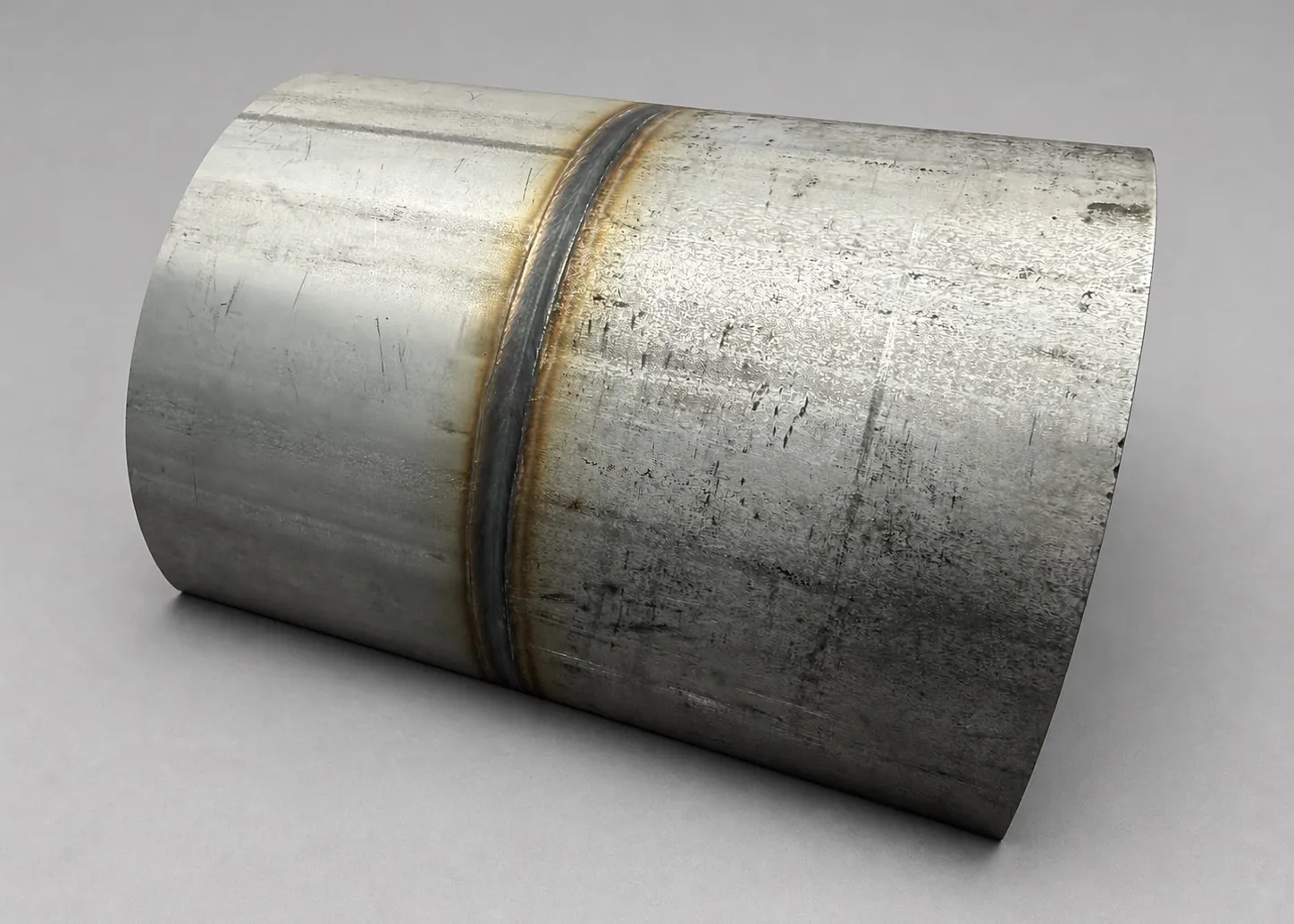
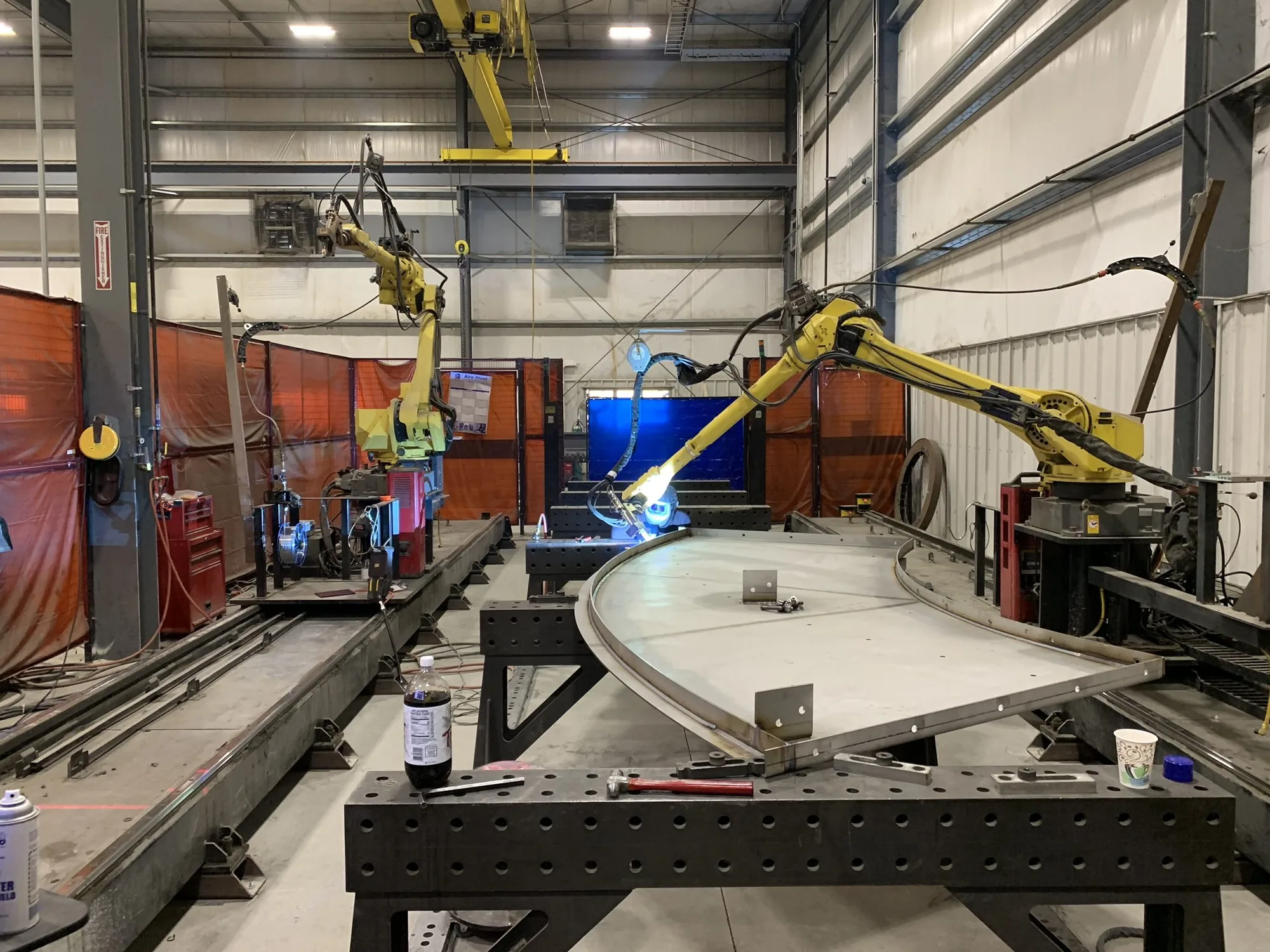
Northern Manufacturing runs robotic GMAW welding cells at our Oak Harbor, Ohio shop, programmed off customer CAD models and backed by a weld department of 60+ AWS-certified welders across 78 bays. Robotic welds run under the same ASME BPVC Section IX and AWS D1.6 qualified procedures as our manual stations, on stainless and carbon steel. Laser vision seam tracking adapts each weld path to the part actually in the fixture, not the part the program assumed.
ISO 9001:2015 certified by AVU Registrations (IAS-accredited, certificate #00157-4). AWS Certified Welding Inspector (CWI) on staff. Stainless robotic work runs under the same free-iron controls as the rest of our stainless welding: dedicated tooling and consumables, with carbon work in separate bays.
Weld Automation Built for Small Batches
Most robotic welding is engineered around volume: one part, thousands of repeats, a fixture that never changes. A job shop doesn’t get that luxury, so our cells are set up to pay for themselves on the quantities custom fabrication actually ships.
Three practices carry the economics:
Multi-fixture setups. Cycle time in a robot cell is usually limited by how fast parts are loaded, not by arc-on time. Our setups run multiple weld fixtures per robot, so an operator loads and unloads one station while the robot welds at another. The arc stays on while the changeover happens.
Modular fixturing. Fixture bases, clamps, and locators are designed to be recombined rather than rebuilt. When a new part shows up, most of its fixture already exists.
Family-of-parts programming. A weld program written for one part in a family is structured to cover its siblings. Program the first bracket and the next four sizes inherit the logic, so programming cost spreads across the whole family instead of landing on one part number.
Laser Vision: Robots That See the Joint
A robot without vision welds where the joint is supposed to be. If the parts feeding the cell vary, or the assembly moves as welding heat distorts it, the weld lands off the joint and the part becomes rework. That constraint kept robotic welding out of most custom fabrication for decades: the robot was consistent, but the weld was only as good as the consistency of the parts entering the cell.
Laser vision removes the constraint. The system measures the actual joint location ahead of the torch and shifts the weld path in real time, compensating for part-to-part variation and for the heat distortion that builds during the weld itself. Fit-up that would scrap a blind robot’s weld gets absorbed, and the rework loop that usually shadows automation goes away.
Programmed Off CAD, Consistent Across the Lot
Weld programs come from your CAD model, not from an operator teaching points on the floor. The torch angle, travel speed, and heat input the WPS calls out are written into the program once and executed identically on the first part and the three-hundredth: bead-to-bead consistency across production lots that no manual process matches on long repetitive runs.
The robots extend the weld department, they don’t replace it. Fixturing, fit-up, and final inspection stay with our craftsmen, robotic welds run under the same qualified Section IX and AWS D1.6 procedures as every other weld in the building, and work that belongs under a hand torch goes to one of our manual welding stations instead.
What Runs Robotically vs. by Hand
Most cell work is 304 and 316L stainless under ASME Section IX P8 qualified procedures, with carbon under P1, the same procedure files our manual stations weld to. Duplex and high-nickel alloys (2205, 2507, AL-6XN, Hastelloy) are evaluated joint by joint and usually run manual GTAW under alloy-specific procedures. For the full qualification list across every grade we weld, see our stainless steel welding services page.
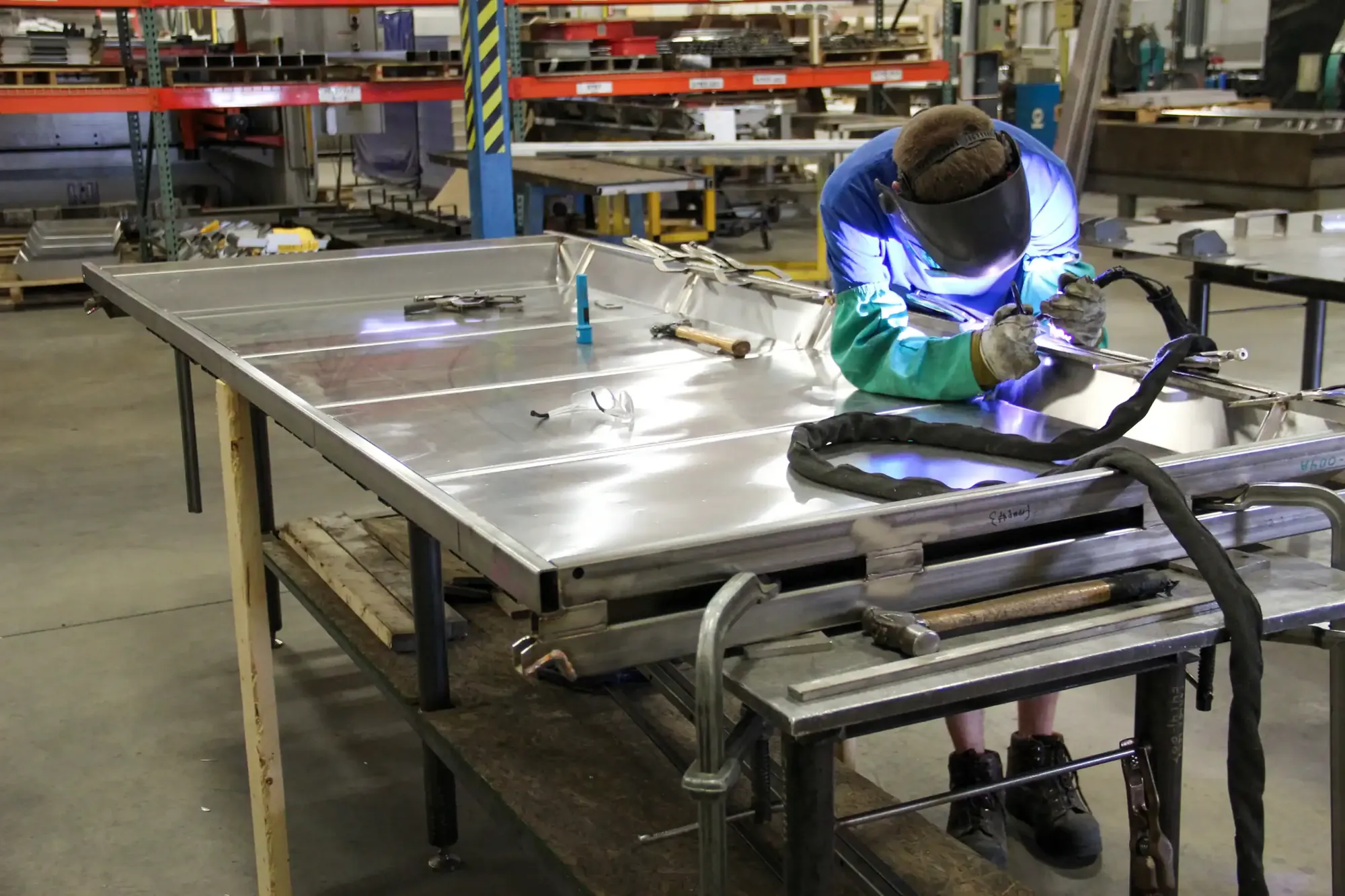
Related work: custom stainless beams
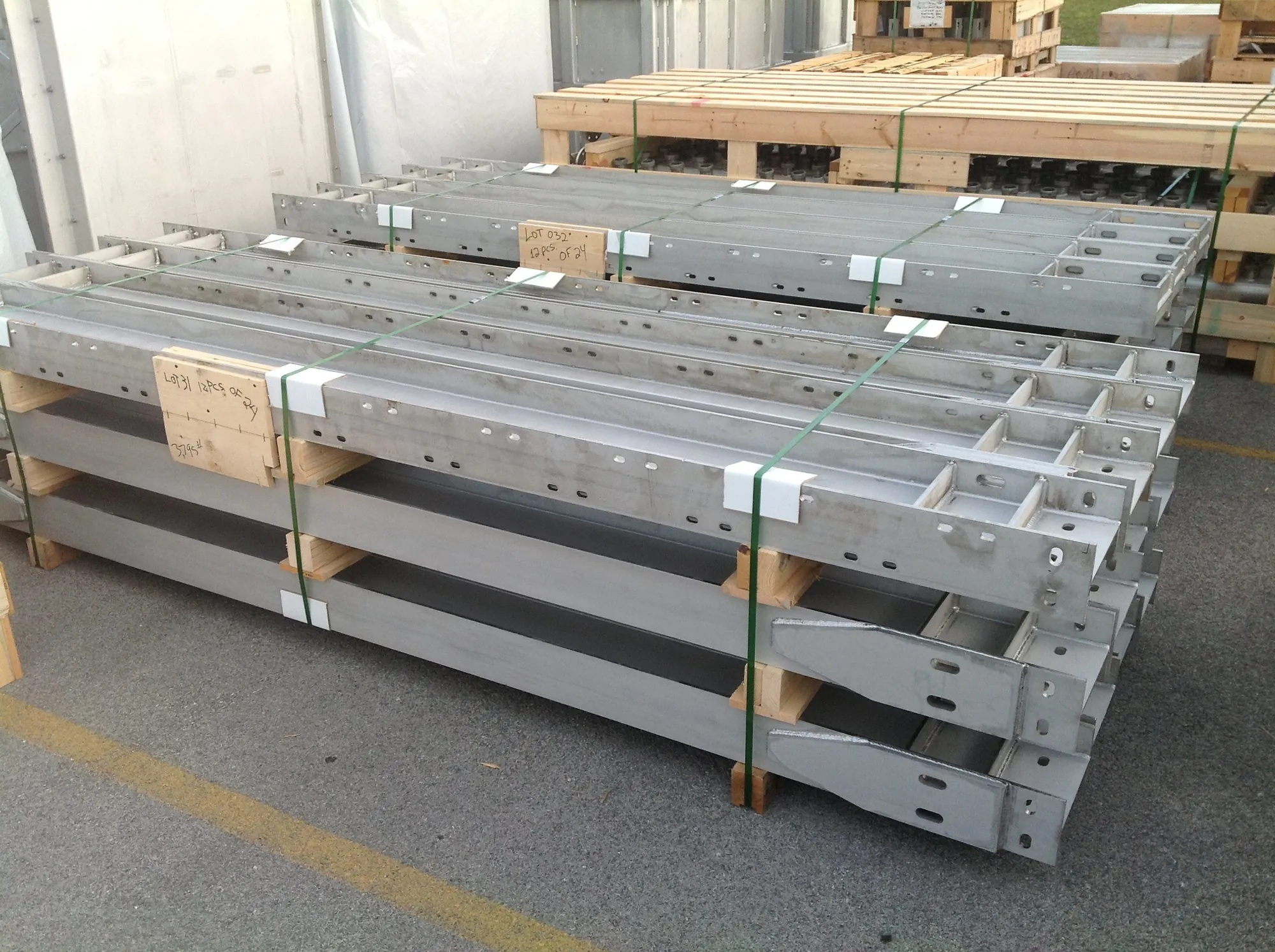
The same robotic stitch welding with laser vision is how we build custom stainless beams when a drawing calls for a section the mills don’t roll. That page covers the beam process. Here the point is the cell: the robot lays repeatable stitch welds down the full length, and the vision system keeps every stitch on the joint as the member moves with heat.