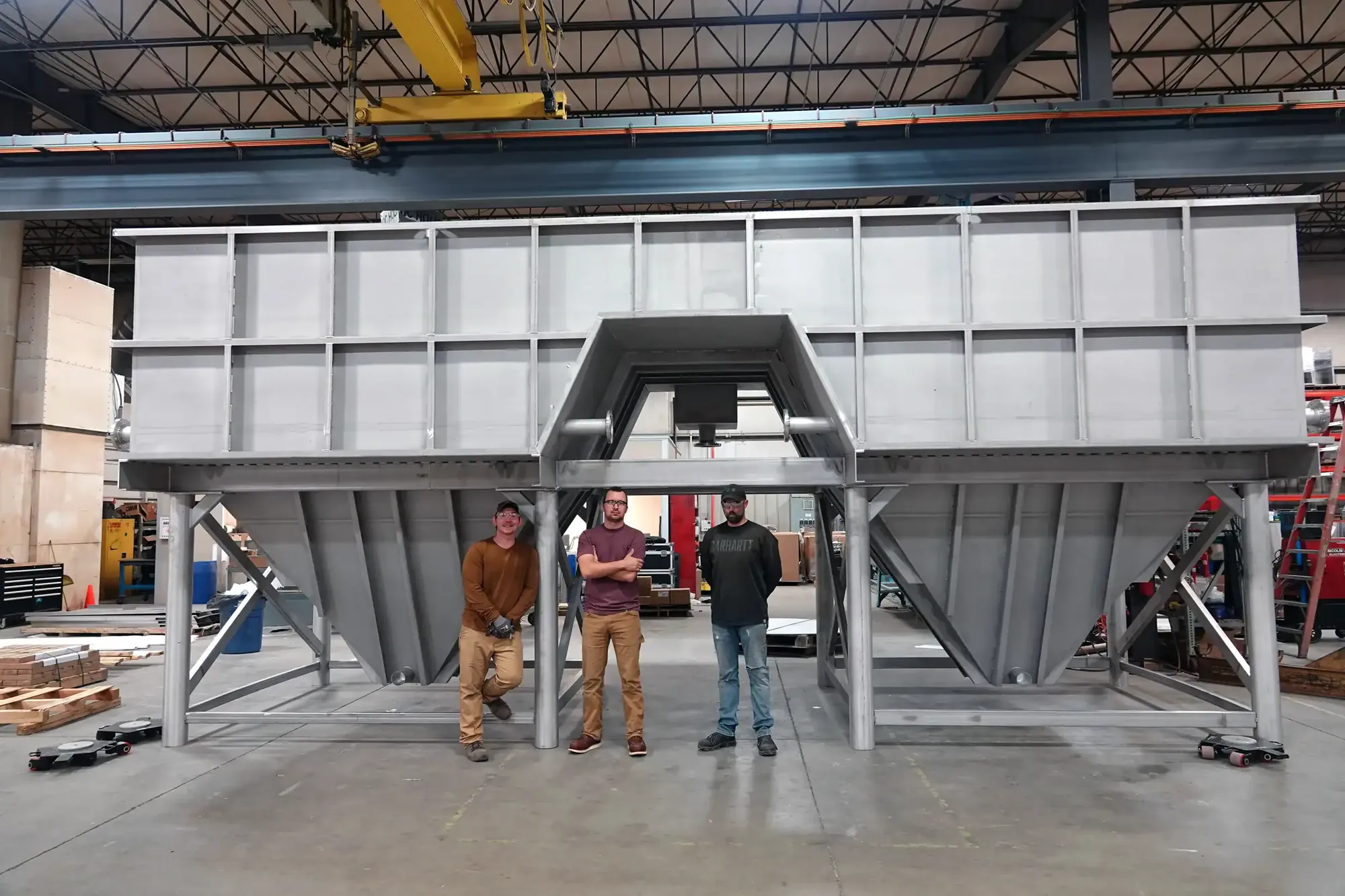
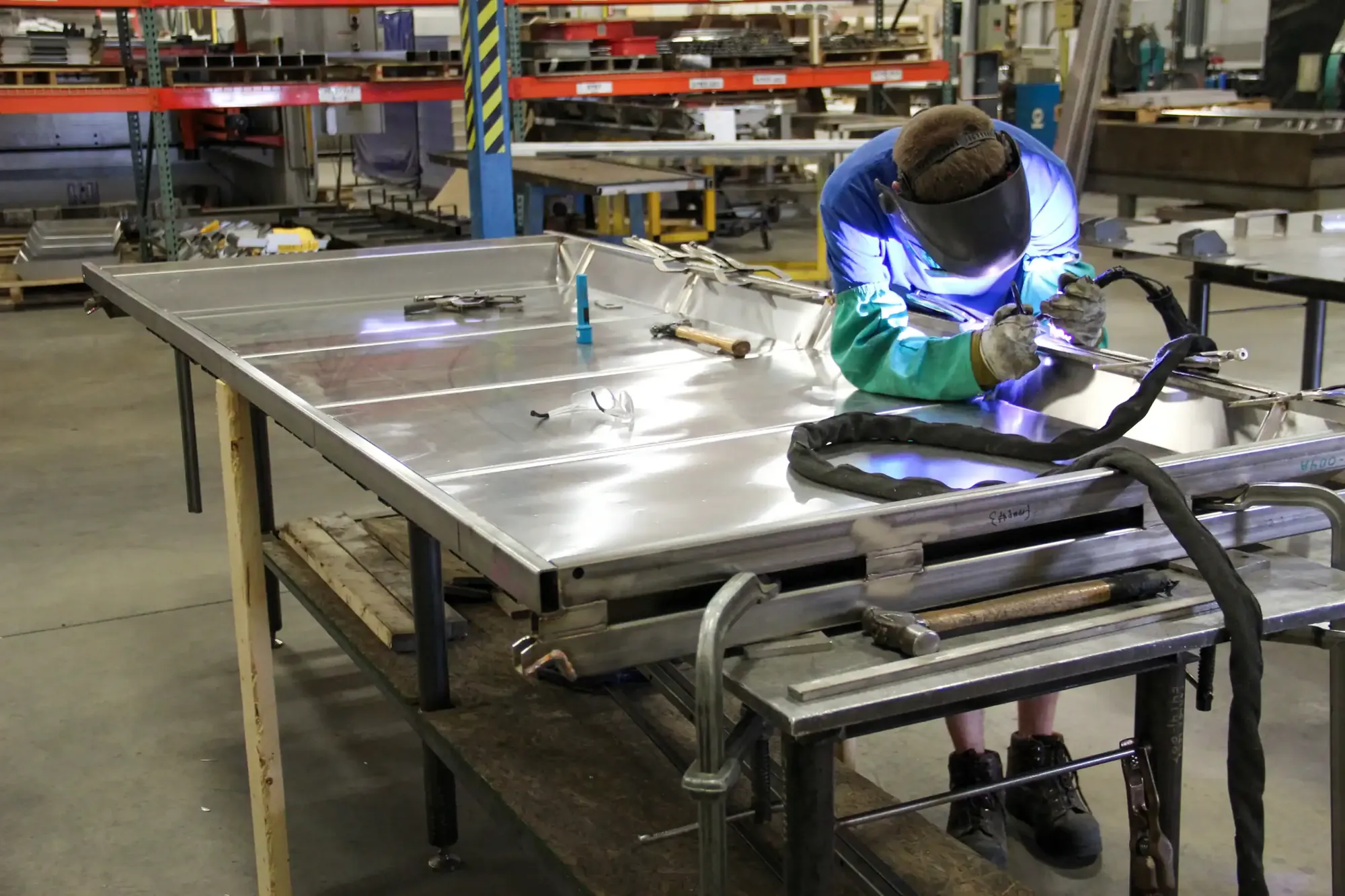
Northern Manufacturing's fabrication team is 160+ craftsmen, including 60+ AWS-certified welders working across 78 welding bays in Oak Harbor, Ohio. A full-time CWI, an in-house ASNT SNT-TC-1A Level III, and procedures qualified per ASME BPVC Section IX and AWS D1.6 back every weld with documented, auditable records.
Welding Qualifications
Welding stainless steel and specialty alloys is not the same job as welding carbon steel. Heat input windows are tighter, interpass temperatures matter more, and mistakes surface months later as corrosion failures or cracking in service. Our welding program exists to stop those failures before they start.
Every weld procedure we run is qualified per ASME Boiler and Pressure Vessel Code, Section IX (2025 edition). Each procedure is proven through destructive testing of qualification coupons, tensile and bend testing at minimum, to confirm it produces sound welds in the specific material, thickness, and joint configuration your drawing calls out.
Qualified procedure coverage spans P8 austenitic stainless (304, 316, 309, 321), P10H duplex stainless (2205, 2507), P43 nickel alloys (Hastelloy C-276, Hastelloy C-22, Inconel 625), and P45 (AL-6XN), plus carbon steel, high-strength low-alloy, and qualified dissimilar-metal combinations for transition joints. The full P-number table lives on our stainless steel welding services page.
Welders are individually qualified under those procedures, and welder continuity logs are maintained current to the fabrication date. When your spec calls for Section IX compliance, the program is already running: no new procedure development, no welder qualification from scratch.
Codes and Stamps Behind the Welds
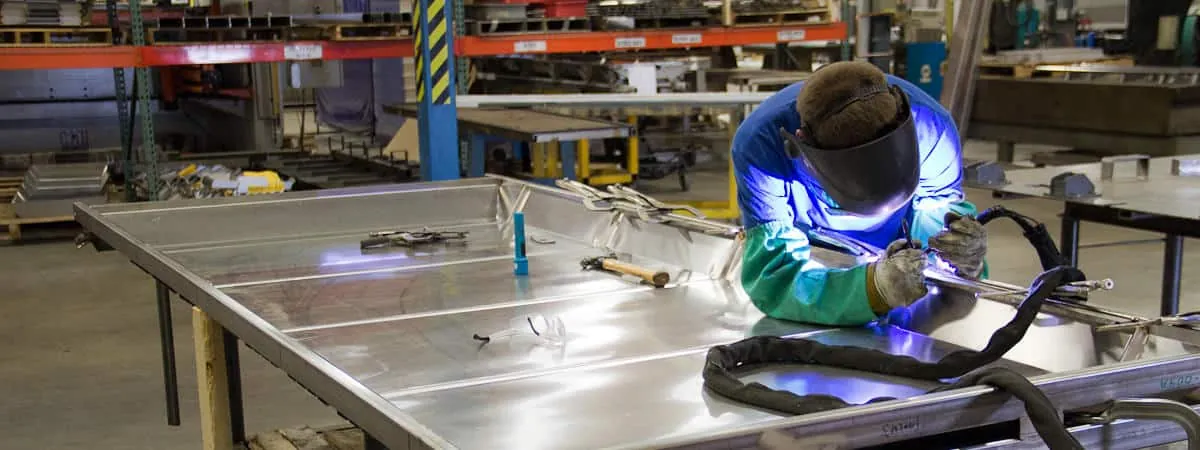
Structural stainless fabrication runs to AWS D1.6, the structural welding code written specifically for stainless steel. It governs joint preparation, fit-up tolerances, welder qualification, and visual acceptance criteria. Our welders also hold qualifications under AWS D1.1 (structural steel) and AWS D1.2 (aluminum), and our resistance spot welder is qualified to AWS D17.2. With 60+ AWS-certified welders on the floor, Northern carries the certified depth to staff several large structural projects at the same time.
One scope note we make early and often: Northern holds the ASME U stamp (Certificate of Authorization #63199, shop manufacture of pressure vessels) and the ASME PP stamp (Certificate #63198, shop fabrication and assembly of pressure piping), both authorized May 2026. Section IX governs the welding qualification underneath both certificates. The certificates cover shop work at Oak Harbor only, not field code fabrication, and we do not hold the R stamp for code repairs or the S stamp for power boilers.
Welding Processes We Run
The team runs nine qualified welding processes, each matched to the joint, the alloy, and the finish the application demands.
GTAW (TIG). The primary process for stainless and specialty alloys. Full-penetration root passes, sanitary finishes, and any joint where weld integrity outweighs deposition rate.
Fronius CMT. Cold-metal-transfer GMAW for thin-gauge stainless and dissimilar joints where spatter and distortion are the failure modes.
Robotic GMAW. Cells programmed off CAD for bead-to-bead consistency on repeat-volume work. See robotic welding.
FCAW (flux-cored). Structural stainless and carbon work where throughput matters more than appearance.
Resistance spot welding. MySpot welder, AWS D17.2 qualified, for sheet assemblies. Northern has also offered laser welding since 1998.
GMAW (MIG). Production welding on stainless, carbon, and aluminum, with transfer mode selected for position and plate thickness.
K-TIG (keyhole TIG). Single-pass full penetration on stainless and duplex up to 1/2 inch thick without joint prep.
SAW (submerged arc). High-deposition longitudinal seams on plate and rolled cylinders.
SMAW (stick). Heavy-section structural and repair work on carbon and HSLA.
Inspection and Testing
Inspection is integrated into the production flow, not waiting on a third party.
Certified Welding Inspector
A full-time AWS CWI on the floor every day, reviewing weld procedures, overseeing welder qualification, performing in-process inspections, and signing off final weld quality.
ASNT Level III NDE
The NDE program is managed in-house by an ASNT SNT-TC-1A Level III, who maintains the written practice, trains and qualifies personnel, and performs or supervises examinations.
Five NDE Methods In-House
Visual (VT), liquid penetrant (PT), magnetic particle (MT), and ultrasonic (UT) testing run in-house, with radiography (RT) coordinated through a qualified NDE partner, per the method your drawing calls out.
Positive Material Identification
Handheld XRF analyzers verify elemental composition on incoming material and finished weldments, confirming the 316L your drawing calls for is actually 316L, not mislabeled 304.
Materials Expertise
Qualification on paper only matters if the team understands the metallurgy behind each grade. Three families make up most of our stainless work.
Austenitic stainless (304, 316, 309, 321, 347). The workhorses, run daily across every process in the shop. Heat input is controlled to keep the heat-affected zone below the sensitization range, and low-carbon L grades are specified where heavier sections demand them. More on austenitic fabrication.
Duplex stainless (2205, 2507, LDX 2101). Roughly twice the yield strength of 316L, and unforgiving on heat input. Our Section IX P10H procedures cap interpass temperature, specify matching filler (ER2209 for 2205, ER2594 for 2507), and require ferrite measurement on production weldments. More on duplex fabrication.
High-nickel and specialty alloys (AL-6XN, Hastelloy C-276, Hastelloy C-22). Specified for the most corrosive environments, fabricated under P43 and P45 procedures with low-heat-input GTAW and filler matched to base-metal chemistry. All of it runs inside our 40,000 sq ft stainless-only production space, and corrosion performance is finished in-house with pickling and passivation per ASTM A380 and A967 in our 55-foot booth. More on specialty alloy fabrication.
Leadership and History
Northern Manufacturing was founded in 1951 in Oak Harbor, Ohio, and has fabricated metal continuously ever since. Tyson Smith and Haley Lonero have owned the company since 2019. Under their leadership, Northern expanded the indoor facility to 160,000 sq ft (completed January 2026) with four new overhead cranes and 90,000 sq ft of outdoor laydown, and invested in robotic welding, laser welding, and 5-axis laser cutting.
The principle behind that growth is simple: invest in the technology and people that make the customer's product better. Stainless fabrication keeps getting more complex, and the shops that stand still fall behind.