Northern Manufacturing verifies fabrication with a Leica Absolute Tracker AT960 with AS1-XL scanner, FARO laser projectors, Servo-Robot WiKi-Scan weld scanning, and handheld XRF analyzers for positive material identification (PMI). Each check produces measured data tied to AWS D1.6 and ASME BPVC Section IX acceptance criteria and recorded under our ISO 9001:2015 quality system. The result is Objective Quality Evidence (OQE): an audit-ready record proving every component meets your specification, instead of asking you to take our word for it.
Why Objective Quality Evidence Matters
Every component we fabricate ends up inside your product, carrying your name. A failure in the field costs far more than the part itself: rework, warranty claims, and a dent in a reputation you spent years building. A certificate of conformance alone says a part passed. It doesn’t show the measurements behind that judgment.
OQE closes that gap. In-process checks and pre-shipment verification generate quantitative records your quality team can audit, file, and hand to your own customers and regulators. For complex or regulated equipment, that evidence is the difference between a supplier you have to police and one you can defend in an audit.
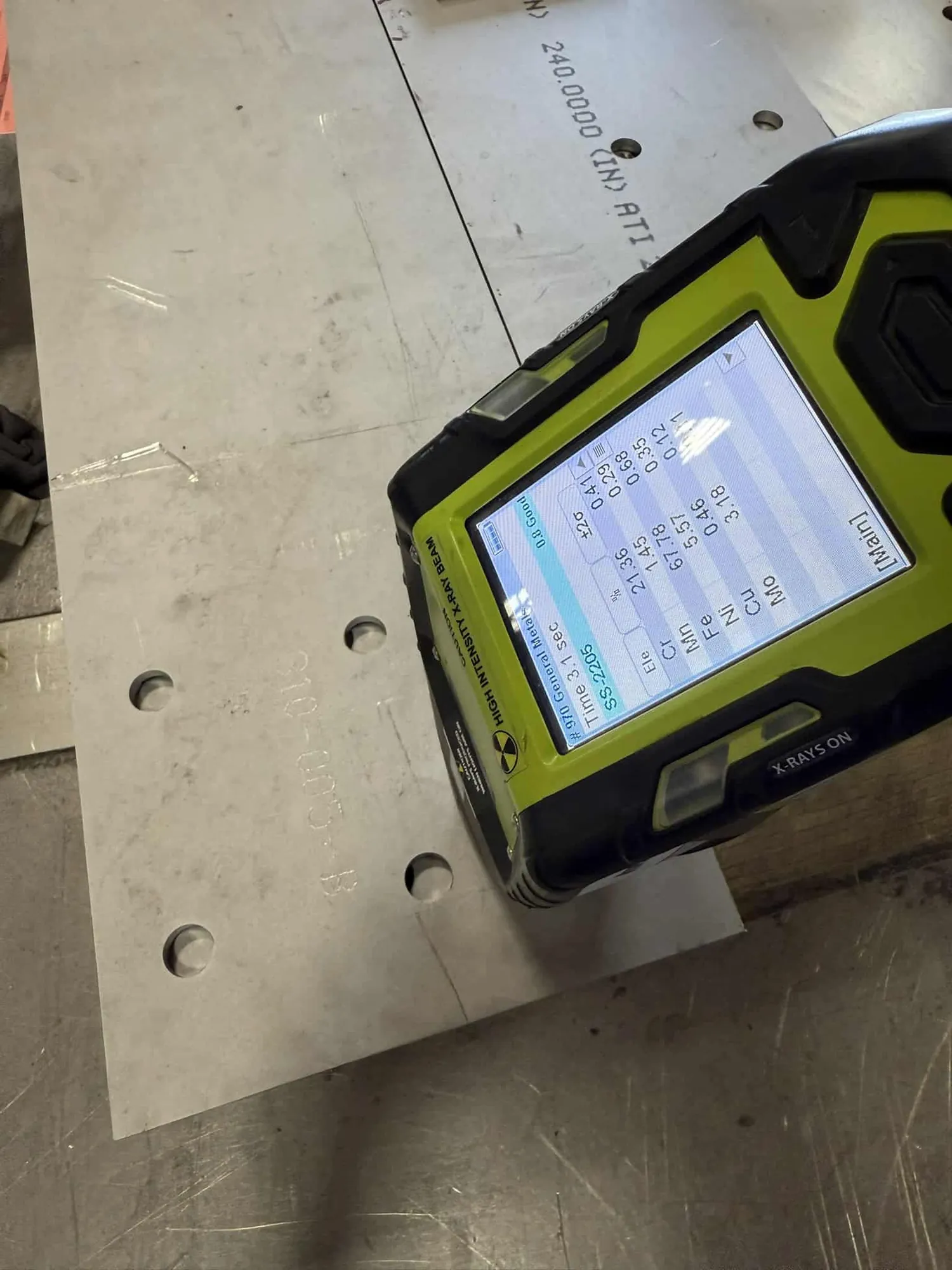
Positive Material Identification: Proof of What the Metal Is
PMI runs on incoming stainless and critical alloys, and on finished goods when your inspection and test plan (ITP) calls for it. Handheld XRF analyzers verify elemental composition on the spot, and every verified piece ties back to its mill test report (MTR) by heat number.
On corrosion-sensitive work, grade certainty is the whole game. A piece of 304 dropped into a 316L job is invisible to the eye and expensive in service. PMI catches the mix-up before the material ever reaches a fixture.
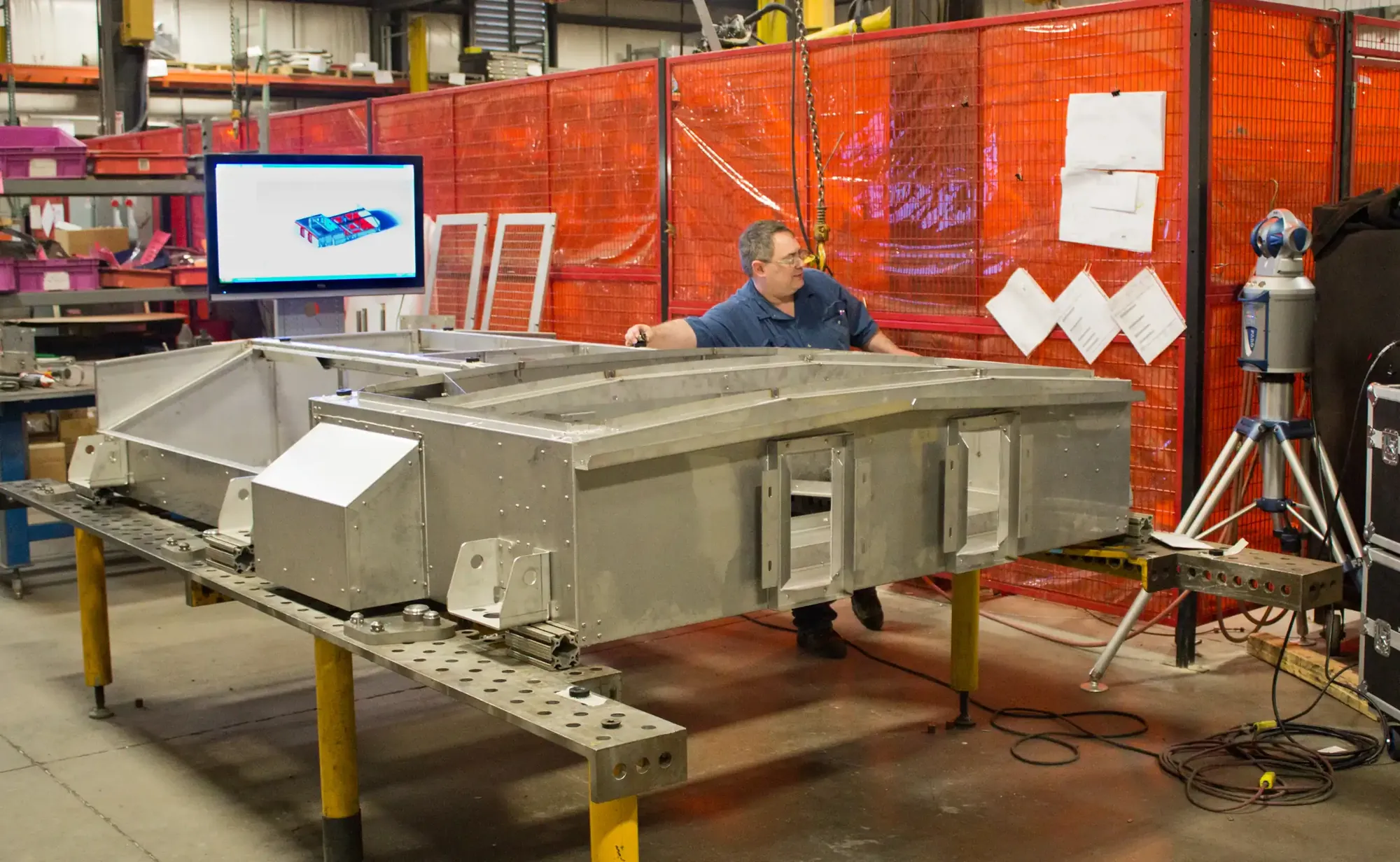
Large-Volume Dimensional Verification: Leica AT960 + AS1-XL
For large assemblies, we capture full 3D scans with the Leica Absolute Tracker AT960 and AS1-XL scanner, then compare the scan directly against the nominal CAD model to verify dimensional accuracy and assembly completeness. Large-volume metrology means the whole weldment gets measured as built, not just the handful of dimensions a tape and square can reach.
This extends our model-based planning approach: the same 3D model that drives fabrication becomes the standard the finished assembly is measured against. For you, that means de-risked field fit-up and digital proof that every specified component is installed where the drawing says it belongs.

Laser Projector Layouts: Error-Proofing Assembly
FARO laser projectors throw CAD-based outlines directly onto the work surface, guiding exact placement of brackets, nozzles, and stiffeners during fit-up. The layout comes straight from the model, not from a tape measure and a memory of the last unit.
On high-mix builds, that is what keeps unit 30 consistent with unit 1. Less layout variability at fit-up means fewer surprises at final inspection, and a cleaner dimensional report at the end.
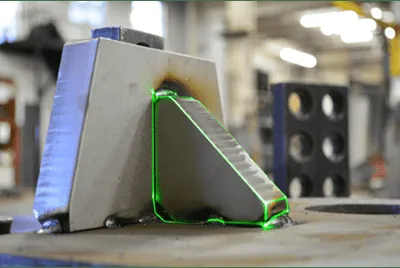
Quantitative Weld Inspection: Servo-Robot WiKi-Scan
The WiKi-Scan captures non-contact 3D scans of finished welds, measuring fillet size, leg length, throat, and undercut as numbers, then compares those measurements to AWS D1.6 and ASME BPVC Section IX acceptance criteria for a documented pass/fail result. A subjective visual judgment becomes quantitative, archivable data.
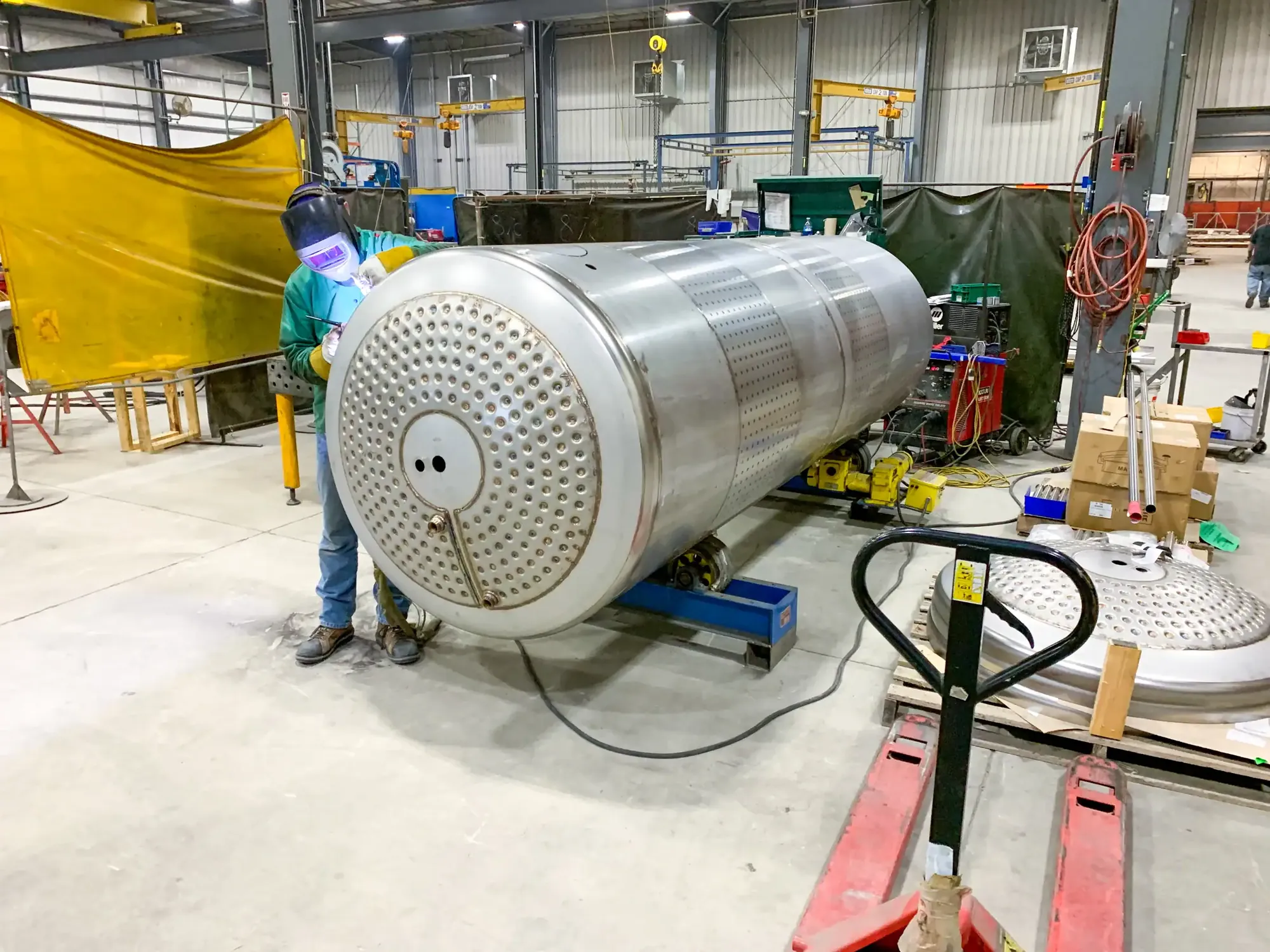
The scanner supplements our inspectors, it doesn’t replace them. A Certified Welding Inspector (CWI) on staff oversees the welding program, and an ASNT SNT-TC-1A Level III governs nondestructive examination. For food processing equipment, weld geometry data supports sanitary cleanability. For water and wastewater equipment, it backs structural reliability with a record you can produce years later.

Measurement Integrity
A measurement is only as good as the instrument behind it. Every inspection and measurement device follows a documented calibration schedule with traceability to NIST, as required under our ISO 9001:2015 quality system. Calibration records are part of what customer auditors review on our floor.
Unless your drawing specifies otherwise, weldment tolerances follow ISO 13920 Class B/F, with precision weldments held to Class A/E. When a spec calls for tighter than ISO 13920 Class A, our engineering team reviews it before we quote, not after we build.

The Quality Report: What Ships With Your Parts
Every verification on this page feeds one deliverable: a project quality report your team can file, search, and defend.
- Dimensional conformance. Scan-to-CAD comparison reports with measured deviations on the assemblies that warrant it.
- Weld evidence. WiKi-Scan quantitative data with code-referenced pass/fail results.
- Material traceability. PMI reports and the full MTR chain of custody, tracked by heat number.
- Quality records. Your project-specific ITP with sign-offs and hold points, plus a certificate of conformance backed by the full evidence set.
Frequently Asked Questions
How do you ensure material traceability?
Every received piece is tagged to its MTR at receiving. PMI on stainless and critical alloys verifies heat chemistry against the certificate, and the heat number follows the material through cutting, forming, and welding. The final documentation package shows the chain from mill to finished assembly.
What is included in the final documentation package?
MTRs and PMI certificates, weld maps identifying the welder and procedure for each joint, dimensional reports, the executed ITP with hold points and sign-offs, and a certificate of conformance. Scope is set per project: tell us what your quality system needs and the ITP is built around it.
How does this support regulatory and customer audits?
The records are objective and traceable: measured values compared to code acceptance criteria (AWS D1.6, ASME BPVC Section IX), produced under an ISO 9001:2015 quality system with NIST-traceable calibration. Whether the review comes from your quality team, your customer, or a regulator, the evidence is already in the file.