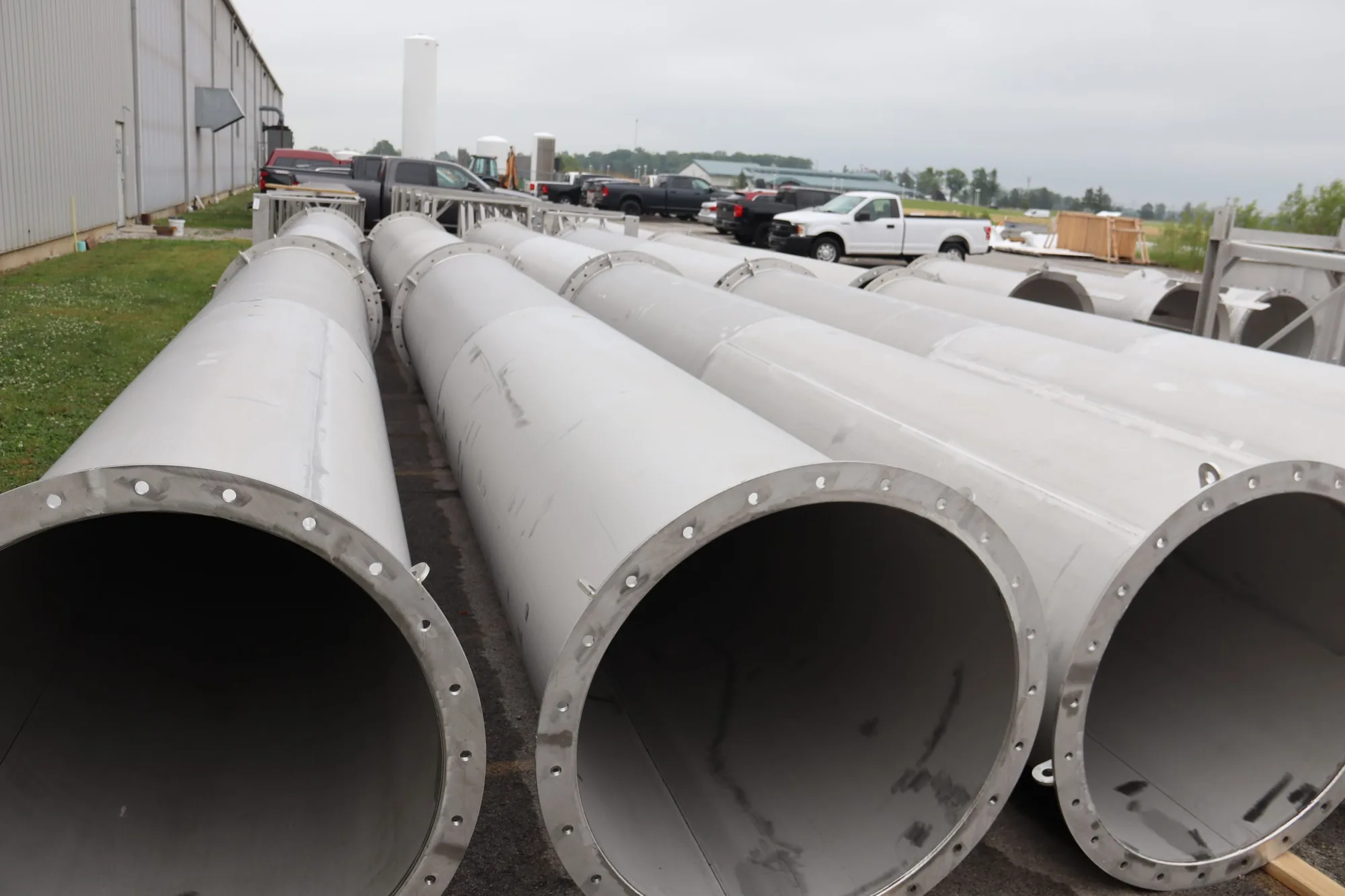
Northern Manufacturing fabricates stainless steel pipe spools, headers, and process piping at our Oak Harbor, Ohio facility. Pressure piping fabricates and assembles in our shop under the ASME PP stamp (Certificate of Authorization #63198, issued May 2026). Welding procedures and welders are qualified to ASME BPVC Section IX across austenitic stainless (P8), duplex (P10H), and nickel alloys (P43, P45), with ASME B31.3-2014 for process piping on file in our Quality Department. A Trumpf TruLaser Tube 7000 cuts pipe and tube from 0.6 to 10 inches in diameter, finished parts to 19 feet 8 inches, so spool components reach the weld bay with copes, miters, and bolt patterns already cut.
ISO 9001:2015 certified by AVU Registrations (IAS-accredited, certificate #00157-4). AWS Certified Welding Inspector (CWI) on staff and ASNT SNT-TC-1A Level III NDE capability in-house. Stainless piping runs inside our 40,000 sq ft stainless-only production space; carbon and aluminum work runs in separate bays, so free iron stays off corrosion-critical pipe.
What We Build
Piping systems are where material selection, weld quality, and documentation all get tested at once, usually by a fluid that punishes shortcuts. The work we quote most:
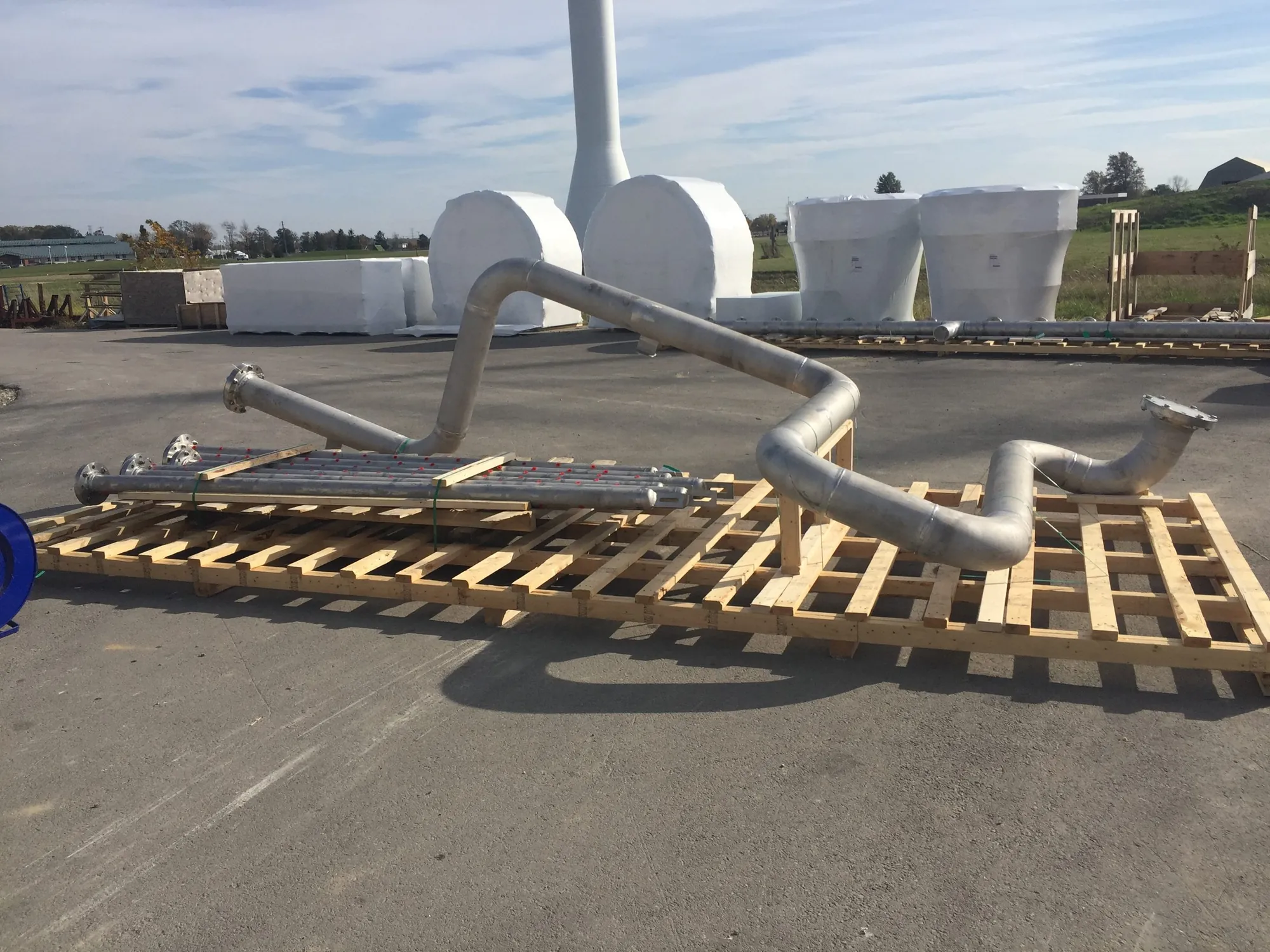
- Pipe spools from your isometrics. Cut, fit, welded, and marked per spool number, ready for field bolt-up.
- Headers and manifolds. Multi-outlet weldments where fit-up accuracy decides whether the field crew bolts or grinds.
- Sanitary and high-purity piping. Purged full-penetration welds, crevice-free interiors, and post-fabrication pickling and passivation for clean-in-place service on food and beverage process lines.
- Transition spools and dissimilar joints. Section IX qualified combinations for stainless to duplex, stainless to nickel alloy, and nickel alloy to nickel alloy.
- Skid piping packages. Piping, frames, and supports fabricated and assembled under one roof and one quality system.
Cutting and Spool Prep
Spool accuracy starts at the cut, not the weld. The tube laser puts copes, miters, slots, and bolt patterns in position at ±0.005 inch in the same cycle that cuts the pipe to length, so joints fit the first time and the welder welds instead of measuring.
| Parameter | Tube laser capacity |
|---|---|
| Diameter | 0.6 in to 10 in |
| Length | Finished parts to 19 ft 8 in; raw tube to 30 ft |
| Wall thickness (stainless) | 3/16 in routine; 5/16 in maximum |
| Features in-cycle | Copes, miters, slots, hole patterns, etch marks |
Hitting one of these limits does not end the conversation. Larger diameters and heavy-wall pipe cut off on the Hydmech S-23A saw with machined end prep where the drawing calls for it, and formed or pre-welded sections route to the Prima Optimo 5-axis laser.
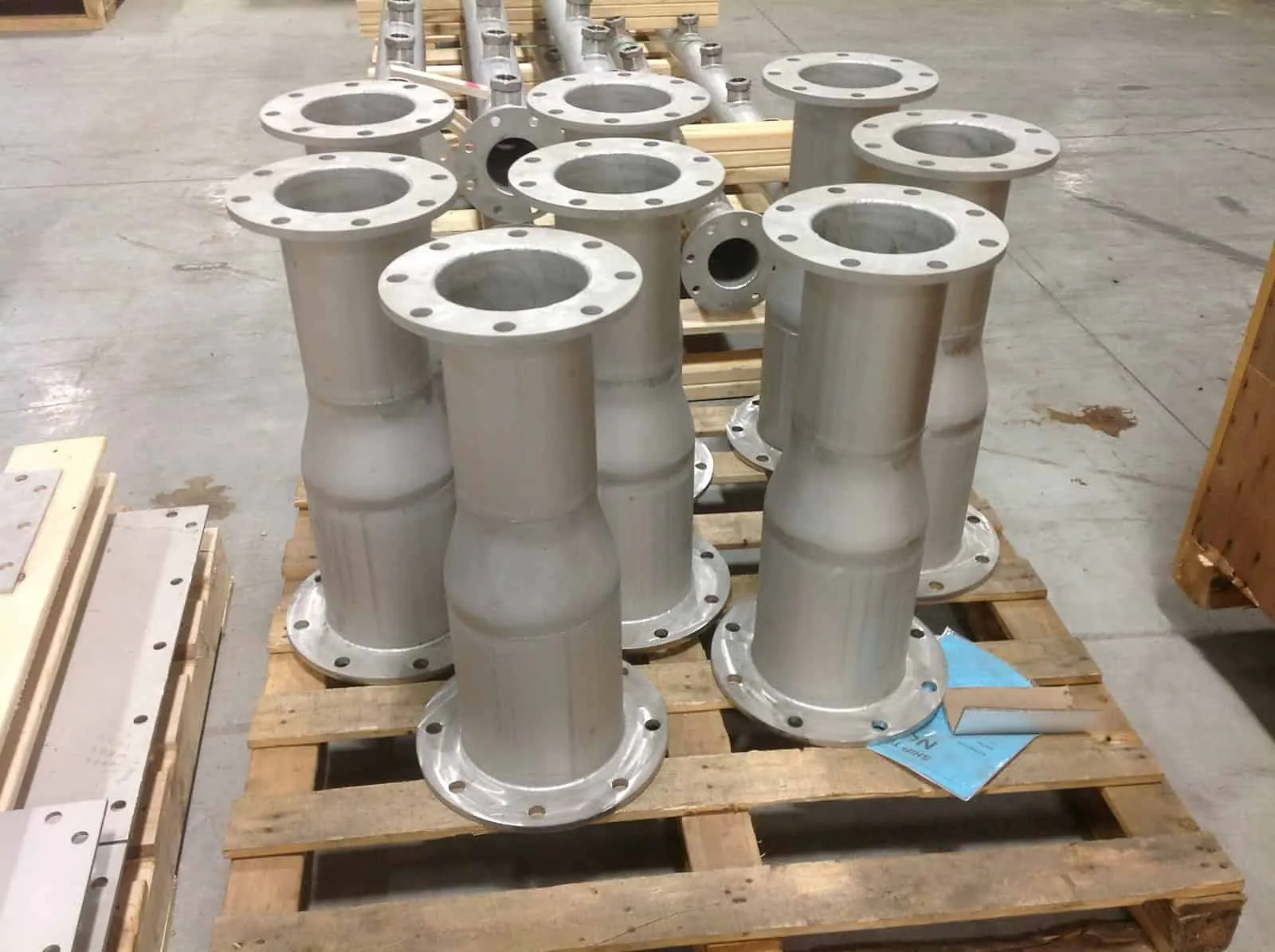
Send the model, not just the isos. Our 8-person engineering department works in SolidWorks and Inventor and reviews piping packages for fabrication before quoting: where a coped joint replaces a fixture, where a one-piece cut replaces a two-piece weldment, where an etch line saves the fitter a layout step.
Welding Pipe From Root to Cap
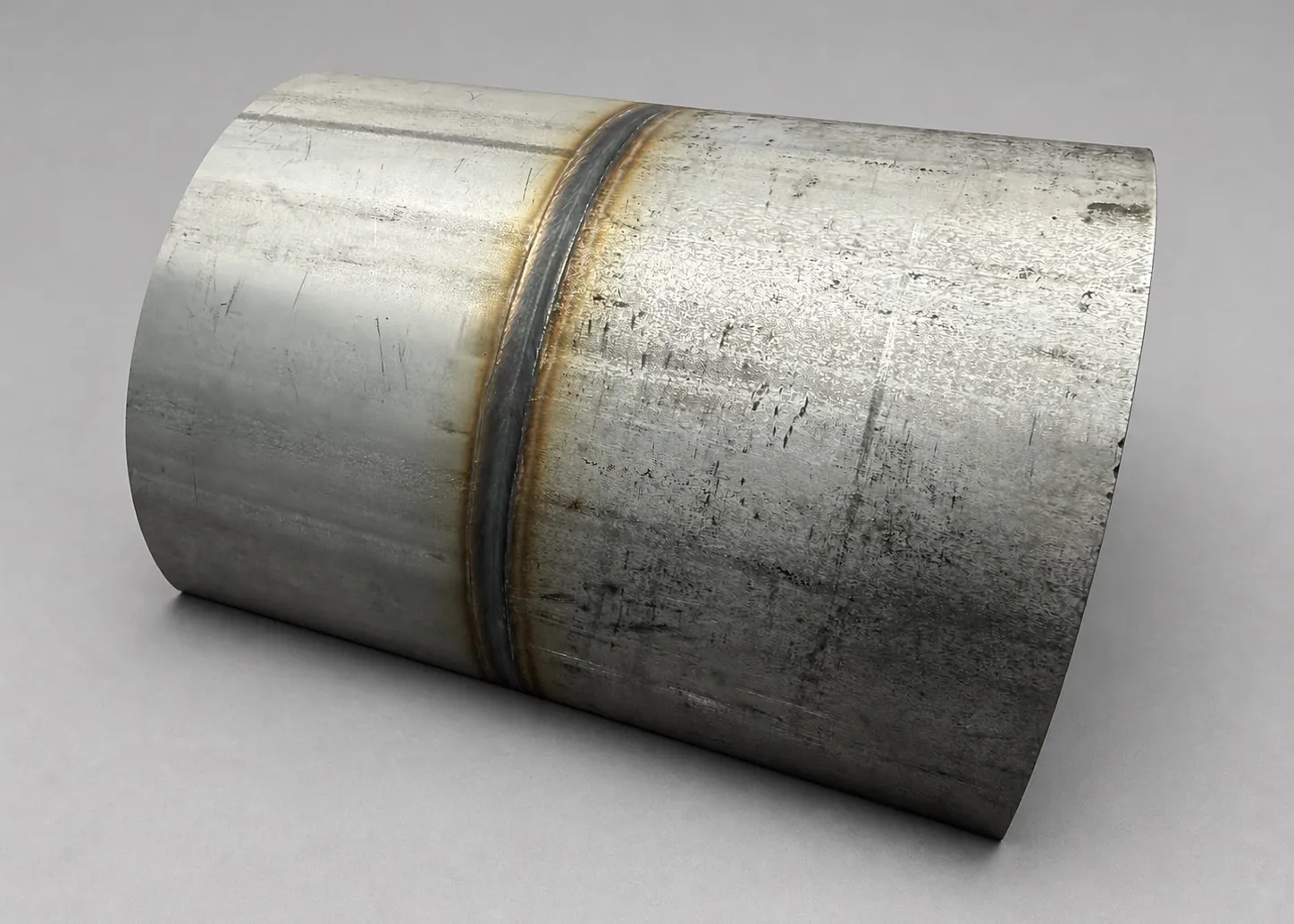
The root pass decides the service life of a stainless pipe weld. Ours run GTAW with an inert gas backing purge on the inside diameter, because interior oxidation on an unpurged root strips the corrosion resistance the alloy was specified for. Fill and cap passes run GTAW, GMAW, or FCAW per the WPS, and K-TIG runs single-pass full-penetration welds on straight seams up to 1/2 inch thick where the geometry fits.
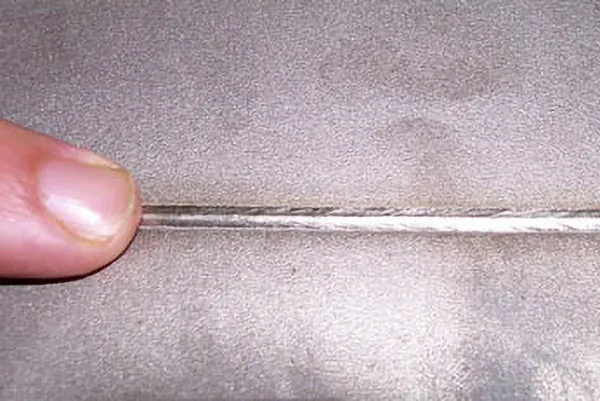
The procedure changes with the metallurgy. Duplex pipe welds run capped interpass temperatures with matching filler (ER2209 for 2205, ER2594 for 2507) and ferrite measurement on production weldments, not just qualification coupons. Hastelloy and Inconel run low-heat-input GTAW with tight bead-width control to manage hot-cracking risk. Heat input is logged against the WPS on every pass.
| Alloy family | Section IX P-number | Where it shows up in piping |
|---|---|---|
| 304L / 316L austenitic | P8 | Process, sanitary, and water piping |
| Duplex 2205 / 2507 | P10H | Chloride service, higher-strength lines |
| Hastelloy C-276 / C-22, Inconel | P43 | Aggressive chemical service |
| AL-6XN, Alloy 31 | P45 | Warm chloride and high-purity corrosive service |
| Dissimilar combinations | P8-P10H, P8-P43, P8-P45, P43-P45 | Transition spools, clad piping |
Verification Before Shipment
Quality on piping is verified, not assumed. Our on-staff CWI inspects to the acceptance criteria your code calls out, and ASNT SNT-TC-1A Level III personnel direct the NDE program: visual (VT), dye penetrant (PT) on root passes, and ultrasonic (UT) on full-penetration joints run in-house, with radiography (RT) coordinated through a qualified NDE partner where the code calls for it. PMI confirms alloy identity on specialty-metal work before a spool ever reaches the weld bay.
After welding, corrosion-critical piping finishes with ASTM A380 pickling and A967 passivation in our 55-foot booth, restoring the passive layer along every weld and cut edge.
Documentation for Your Piping Package
We can provide documentation as your purchase order requires:
- Material Test Reports (MTRs) traced by heat number from raw stock through finished spool
- Weld maps identifying every joint, its WPS reference, and the welder stamp
- Welder qualification and continuity records current to the fabrication date
- NDE reports (VT, PT, RT, UT as specified on the drawing)
- Ferrite measurement records for duplex welds
- PMI records for specialty-alloy work
- Pickling and passivation certificates when finishing is in scope
- Certificate of Conformance (CoC) to your purchase order
If your specification calls for a document we have not listed, our quality department scopes it during quote review, before fabrication starts.
Repeatable Full Penetration Starts Before the Arc
Repeatable full penetration on pipe starts before the arc. On one process-piping program, the job needed butt welds that would pass radiography on every joint, in a high-chromium austenitic stainless that punishes inconsistent prep. The variable that defeats full penetration on pipe is fit-up. A bevel ground by hand drifts joint to joint, and the root fuses differently each time. We cut the weld bevel on the tube laser so the prep geometry is identical across the run, then welded to that prepared joint in a robotic cell under welding procedures and welders qualified to ASME BPVC Section IX (P-No. 8). The bevel does the same thing every time, so the root does too. Joints were verified by radiography against the acceptance criteria in the piping package, with the welder and procedure stamped on the weld map. For pressure-piping work, our Oak Harbor shop fabricates under the ASME PP stamp (Certificate of Authorization #63198). The result is full-penetration pipe welds you can prove, without machine-beveling every joint.