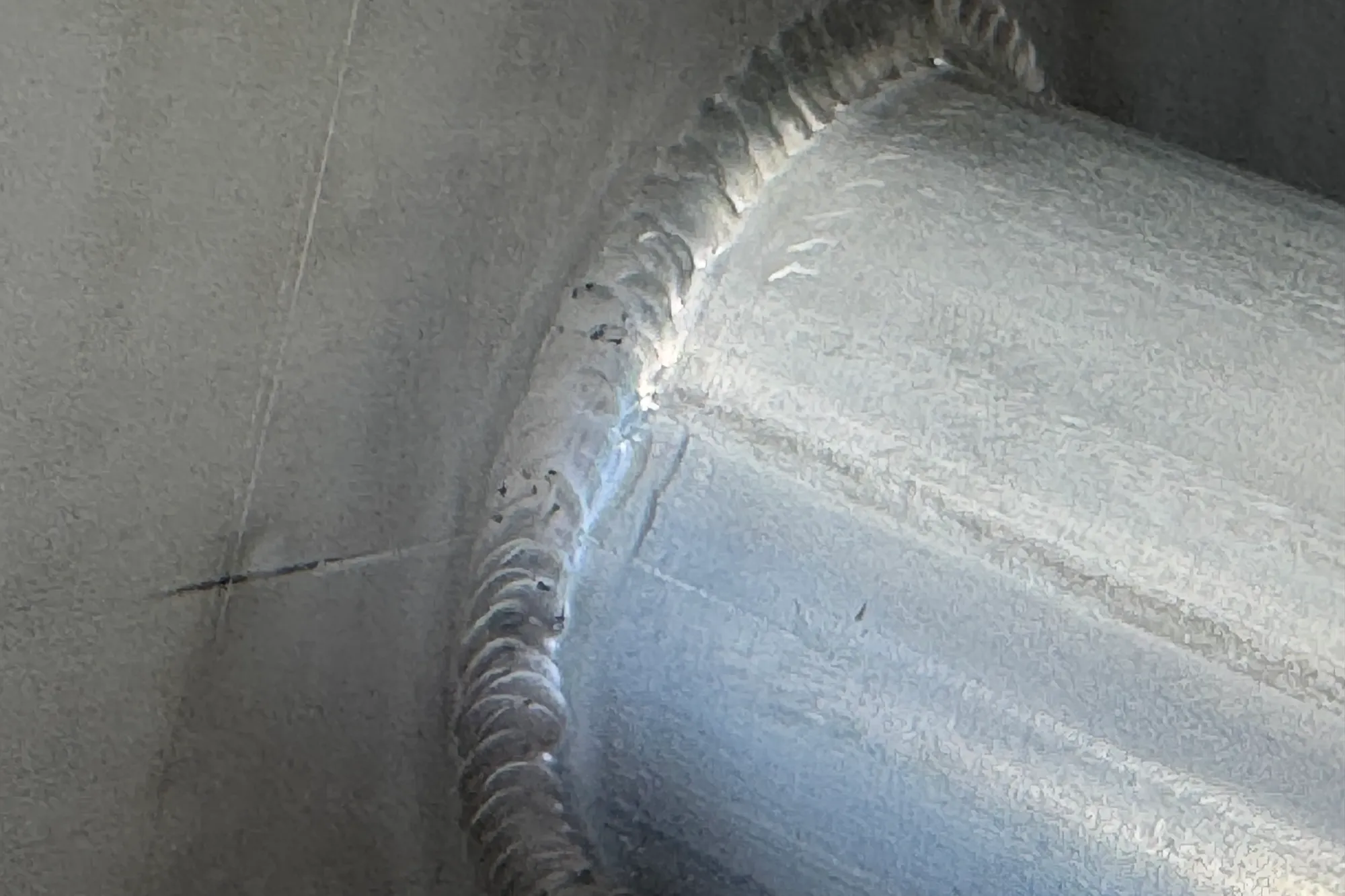
Small black or glassy spots on a finished stainless steel MIG weld are silica islands: high-melting-point deposits of silicon and manganese oxides that float to the surface of the weld pool and solidify there. They are a natural byproduct of the GMAW (MIG) process, they are not porosity or lack of fusion, and no major structural welding code requires their removal. ASME BPE-2024, the strictest surface-quality standard in common use, explicitly permits adherent oxide islands on most weld surfaces.
They also cause more disputes at final inspection than almost any other cosmetic weld condition, because most stainless steel fabrication specs never mention them. This paper explains the metallurgy, walks through what the governing standards actually say, and gives engineers and buyers concrete language to put in a spec so the question gets answered at the quote, not at the receiving dock.
What Silica Islands Are
Stainless steel filler wires such as ER308L and ER316L contain deliberate additions of silicon and manganese. These elements are deoxidizers. Their job is to scavenge oxygen out of the molten weld pool before it can form porosity or oxide inclusions inside the weld. The reaction products, mostly manganese silicates rather than pure silicon dioxide, are lighter than molten steel. They float to the surface of the pool and freeze as small glassy deposits, typically at the toes of the weld and at the crater where each bead ends.
On carbon steel they read as brown or amber glass. On stainless, against a bright passivated surface, they show up as small black spots, which is why they draw attention on stainless work that would pass without comment on carbon steel.
Two things silica islands are not:
- Not slag. AWS A3.0 defines slag as the nonmetallic product of flux-based processes. Solid-wire GMAW uses no flux. ASME BPE-2024, Nonmandatory Appendix A, draws the same line: it identifies these deposits as high-melting-point nonmetallic oxides, “typically referred to as oxide islands,” and distinguishes them from slag. Some inspectors group them with slag anyway, which is exactly why specs should name them explicitly.
- Not a strength defect. The islands sit on the surface of the solidified bead. They do not create inclusions in the weld metal, and welding over them on multi-pass work does not trap defects. The concerns they raise are cosmetic and, in hygienic or coated applications, functional at the surface. The corrosion question deserves data rather than assumption, and we tested it; see the lab results below.
Why GMAW Cannot Fully Avoid Them
GMAW on steel requires an oxidizing component in the shielding gas. Pure argon produces an erratic, wandering arc on ferrous material, so stainless GMAW runs argon blended with 1 to 2% oxygen or a small percentage of CO2. That oxygen is what stabilizes the arc, and it is also what reacts with the silicon and manganese in the wire. The chemistry that makes the process work is the same chemistry that makes the islands.
Wire selection, gas selection, and technique change how many islands form and where they sit. Lower-silicon wires, lower CO2 content, and lower heat input all help. Nothing eliminates them. A fabricator who promises silica-free GMAW stainless welds is promising something the process chemistry does not allow.
GTAW (TIG) is the exception, because it runs 100% argon with no oxidizing addition. With good gas coverage and technique, GTAW welds on stainless come out essentially free of oxide islands. Even here, ASME BPE hedges: its Appendix A notes that a small black spot at the termination of a weld bead on stainless “is generally unavoidable.” GTAW gets you close to zero, not a guarantee of zero.
The catch is cost. A single GTAW pass tops out around a 3/16 inch fillet. Structural stainless weldments with 1/4 inch and larger welds that GMAW completes in one or two passes become four, six, or more GTAW passes at a fraction of the travel speed. On large weldments, specifying GTAW purely to avoid silica islands can multiply welding hours several times over. It is a legitimate choice for hygienic process surfaces. It is an expensive choice for structural supports and non-contact surfaces, and it should be a deliberate one.
What Independent Lab Testing Shows
Northern Manufacturing commissioned two rounds of independent testing on GMAW bead-on-plate samples (304/304L base metal, ER308/308L filler) through TMR Stainless, a metallurgical consultancy in Pittsburgh, in late 2025.
SEM/EDS characterization. Four black island sites were analyzed by scanning electron microscopy and energy dispersive spectroscopy. Every island came back as a manganese-silicon-rich oxide: roughly 16 to 35 weight percent silicon, 10 to 37 percent manganese, and 18 to 43 percent oxygen, with minor chromium, titanium, and aluminum. That confirms the deoxidation chemistry by instrument rather than inference. These are oxide deposits from the wire’s deliberate deoxidizers, not slag and not contamination.
ASTM G48 Method A corrosion testing. A welded coupon carrying one large silica island at the weld crater and numerous small islands along the bead was immersed for 24 hours in ferric chloride solution at 10 degrees C. G48-A is a severe pitting screening test, considerably more aggressive than most real service environments for 304 stainless. Pitting corrosion initiated adjacent to the large crater island. The small silica islands showed no corrosive attack, confirmed by SEM examination after exposure.
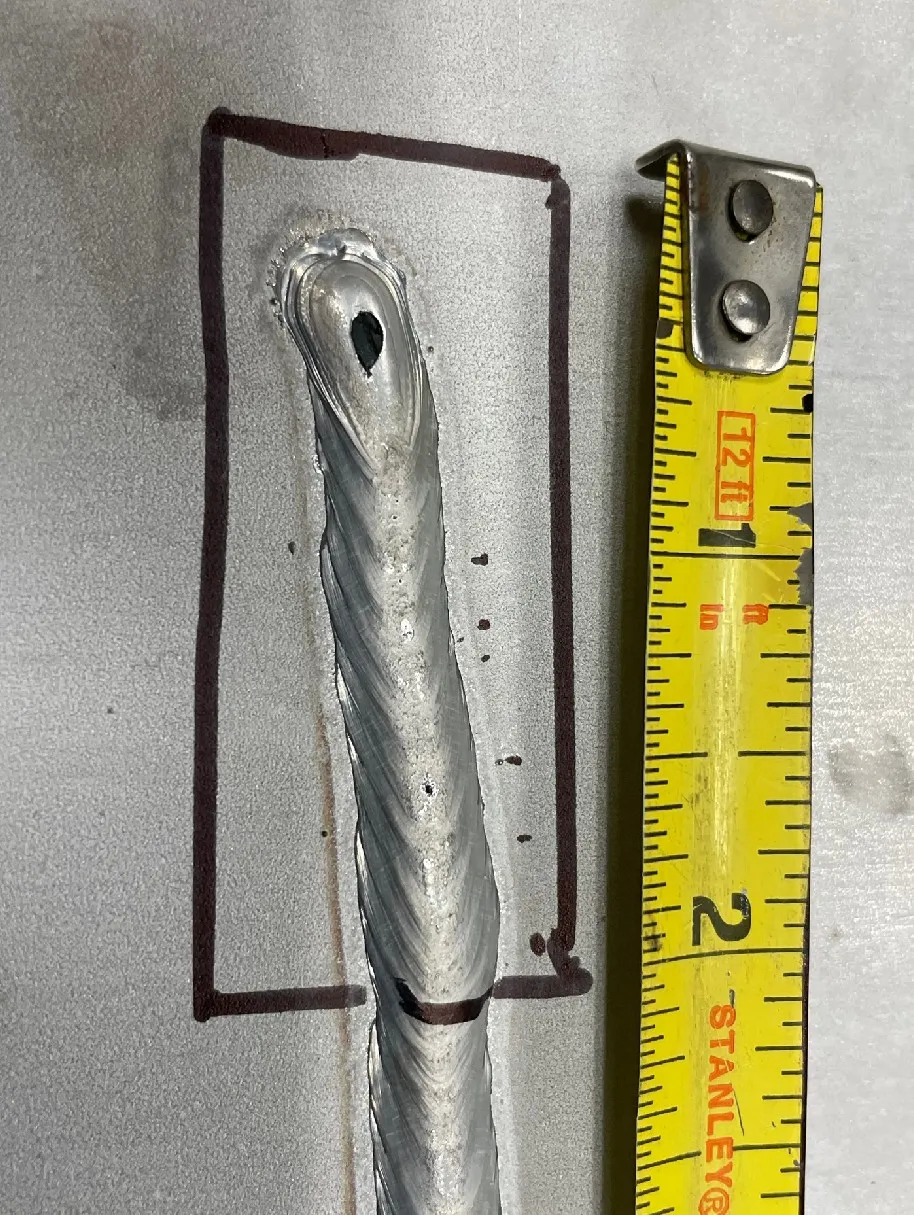
The G48 test coupon: the marked test area on the weld bead, with the large silica island at the crater termination. Testing by TMR Stainless, reports 25-140.
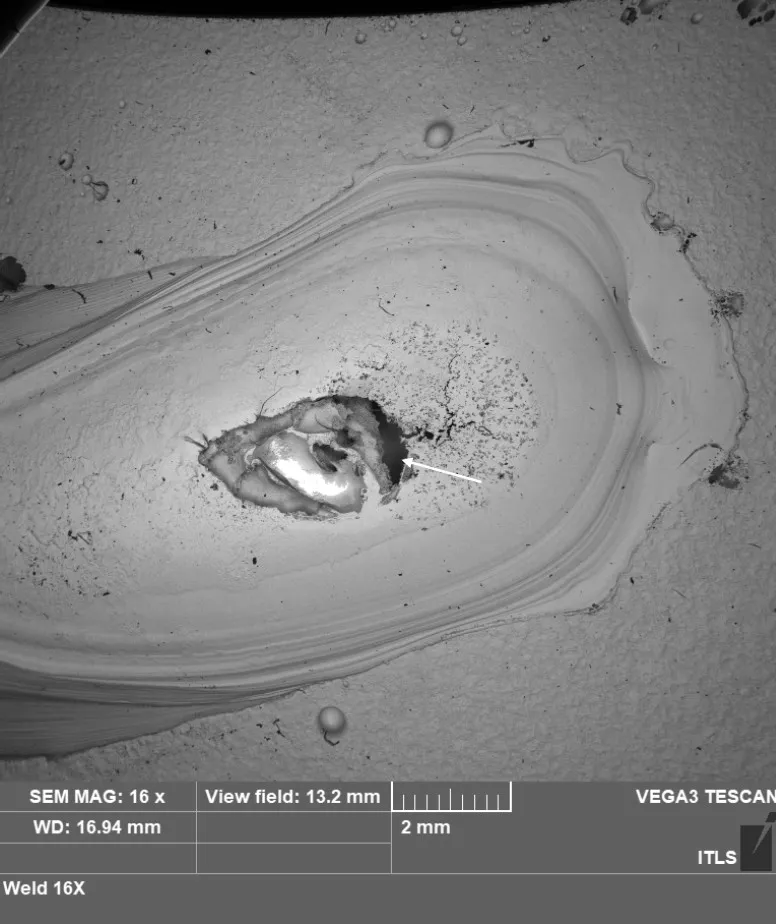
SEM view of the large crater island site at 16x magnification. Image courtesy of TMR Stainless, reports 25-140.
One coupon is directional evidence rather than a design rule, but the direction is clear. Small adherent islands survived a chloride exposure far harsher than anything a structural support or water treatment frame will see. The large island at the weld termination was the initiation site. For aggressive chloride service, that argues for a targeted criterion: remove large crater islands, accept small adherent ones. Blanket removal of every visible speck buys appearance, not corrosion resistance.
What the Standards Say
This is where most disputes start, because the answer surprises people on both sides of the purchase order.
| Standard | Scope | Silica / oxide island treatment |
|---|---|---|
| AWS D1.6/D1.6M, Structural Welding Code - Stainless | Visual acceptance of structural stainless welds | Not listed as a discontinuity or rejectable condition; the slag-removal rule does not reach flux-free GMAW deposits |
| ASTM A380 | Cleaning, descaling, and passivation of stainless | No acceptance criteria; passivation chemistry does not dissolve the islands |
| ASME BPE-2024 | Bioprocessing equipment welds | Permitted where adherent to the surface, on process contact and non-process contact surfaces alike; prohibited only on process contact surfaces after postweld finishing |
AWS D1.6/D1.6M, Structural Welding Code - Stainless Steel. The visual acceptance criteria (Table 8.1 in the 2017 edition) cover cracks, fusion, craters, weld profiles, undercut, and porosity. Oxide and silica islands are not listed as a discontinuity or a rejectable condition. The code does require that slag be removed from completed welds; as noted above, deposits from a flux-free process do not meet the AWS A3.0 definition of slag, though an owner can always impose a stricter reading in contract documents.
ASTM A380, Standard Practice for Cleaning, Descaling, and Passivation of Stainless Steel. Covers removal of free iron, scale, heat tint, and contamination, and defines the passivation treatments themselves. It contains no acceptance criteria for silica or oxide islands. A weldment can be fully cleaned and passivated per A380 and still carry every island the welding process left behind. Passivation chemistry does not dissolve them.
ASME BPE-2024, Bioprocessing Equipment. The only widely used standard that addresses oxide islands by name, and it comes from the most surface-critical industry there is. Its visual examination tables for pressure vessels, tanks, pipe, and tube welds (Tables MJ-8.2-1, MJ-8.3-1, MJ-8.4-1, and MJ-8.5-1) all carry the same entry: oxide islands are permitted, on process contact and non-process contact surfaces alike, “as long as they are adherent to the surface.” Reflective color is specifically not a cause for rejection. The one place BPE prohibits them is on process contact surfaces after postweld finishing, meaning surfaces that are being mechanically polished to a specified surface finish anyway.
Read that again in context: the standard written for pharmaceutical-grade equipment, where product purity is the entire point, accepts adherent oxide islands on non-process surfaces without qualification. A water treatment support frame or a structural skirt is a far less demanding application than a bioreactor shell.
The adherence test is the useful part. BPE’s distinction between adherent and loosely adhered islands maps directly onto shop practice. Loosely adhered islands come off with a Scotch-Brite pad in seconds. Tightly adherent islands resist aggressive abrasives and can take several minutes of grinding per spot, and the grinding leaves bright scratch marks at every location that many owners find worse-looking than the islands themselves.
The Inspection Trap
There is a practical failure mode worth naming, because we have lived it. When a project team decides mid-job that silica islands must go, without an acceptance criterion in writing, the definition of “gone” has no floor. First the visible spots get removed. Then inspection finds smaller flakes under better lighting. Then re-inspection finds specks that are invisible to the unaided eye at arm’s length. Each round adds grinding marks, re-cleaning, and hours, and the weldment looks progressively worse while everyone works in good faith.
The fix is not better grinding. The fix is a written criterion: viewing distance, lighting, whether adherent islands are acceptable, and what surfaces the criterion applies to. BPE’s framework (adherent permitted, loose removed, finished process surfaces held to a higher bar) is a proven place to start, and it exists precisely because the bioprocessing industry went through the same loop.
What to Put in Your Spec
For engineers writing fabrication specs and buyers issuing purchase orders on stainless weldments, three workable positions, in order of cost:
- Accept adherent oxide islands. Reference ASME BPE-2024 Table MJ-8.5-1 criteria or equivalent language: oxide islands permitted where adherent to the surface, loosely adhered islands removed. This is the no-cost-adder position and the right one for structural, architectural-secondary, and non-contact surfaces. For aggressive chloride service, add a size trigger consistent with the corrosion data above: large islands at weld craters and terminations removed, small adherent islands accepted.
- Specify mechanical removal with an appearance allowance. Loosely adhered islands removed with non-woven abrasive (Scotch-Brite or equivalent); resulting light abrasive marks acceptable. In our experience this clears roughly three quarters of visible islands quickly. State explicitly whether tightly adherent islands must also be ground out, because that is where the cost and the cosmetic damage concentrate.
- Specify GTAW for exposed welds. Near-total prevention rather than cleanup. Expect a significant price difference on weldments with structural-size welds, and expect the quote to say so.
The three positions at a glance:
| Spec position | Language to use | Cost impact |
|---|---|---|
| Accept adherent oxide islands | ASME BPE-2024 Table MJ-8.5-1 criteria or equivalent: adherent islands permitted, loosely adhered islands removed; for aggressive chloride service, add a size trigger (large crater islands removed, small adherent islands accepted) | No cost adder |
| Mechanical removal, appearance allowed | Loosely adhered islands removed with non-woven abrasive; light abrasive marks acceptable; state whether tightly adherent islands must also be ground out | Moderate; concentrates wherever tightly adherent islands must be ground |
| GTAW on exposed welds | Exposed welds GTAW; islands prevented rather than removed | Significant on weldments with structural-size welds |
Whichever position you take, take it in the RFQ. A fabricator can price any of the three. What no one can price is a criterion that arrives after the welds are done.
How Northern Manufacturing Handles It
Northern Manufacturing fabricates stainless steel weldments across GMAW, GTAW, and seven other qualified welding processes, with weld procedures qualified per ASME BPVC Section IX and AWS D1.6. Our 60+ AWS-certified welders run 304/304L, 316/316L, duplex 2205, and high-nickel alloys daily, and our in-house pickling and passivation line processes assemblies up to 55 feet per ASTM A380.
When a customer’s application cannot tolerate oxide islands, we say so at the quote and price the job accordingly, whether that means GTAW on exposed welds or a defined removal-and-inspection scope. When the spec is silent, we flag the question on projects where surface appearance matters. That conversation costs nothing before fabrication starts. For how we hold weld acceptance criteria when the spec is demanding, see our full-penetration pipe welds case study, where every joint passed radiography against the piping-package criteria.
If you are writing a spec for stainless fabrication and want a second set of eyes on the weld acceptance criteria, send it to sales@northernmfg.com or call (419) 898-2821.
Have a stainless weldment on the board? Send your spec with a quote request and name the surface acceptance position you want priced.
References
- AWS A3.0M/A3.0, Standard Welding Terms and Definitions, American Welding Society
- AWS D1.6/D1.6M, Structural Welding Code - Stainless Steel, American Welding Society
- ASTM A380/A380M, Standard Practice for Cleaning, Descaling, and Passivation of Stainless Steel Parts, Equipment, and Systems
- ASME BPE-2024, Bioprocessing Equipment, Tables MJ-8.2-1 through MJ-8.5-1 and Nonmandatory Appendix A, American Society of Mechanical Engineers
- ASTM G48, Standard Test Methods for Pitting and Crevice Corrosion Resistance of Stainless Steels and Related Alloys by Use of Ferric Chloride Solution
- TMR Stainless, T304 Stainless Steel Weld Analysis, reports 25-140, October 24 and November 21, 2025 (SEM/EDS characterization and ASTM G48-A testing commissioned by Northern Manufacturing)