A tube laser cuts every edge normal (perpendicular) to the tube surface. It follows the cope or miter profile you model in the plane of the tube, but the cut face is left square to the wall it passes through. That means a standard tube laser cutting quote does not include a beveled or knife edge through the wall thickness. If your part needs a true bevel or weld prep, that is a separate feature we quote when you call it out on the model.
This page shows what “normal to the surface” looks like on two common parts, so there are no surprises between the 3D model and the parts that come off the machine.
Why the Cut Edge Comes Out Square
The cutting head tracks the outside of the tube and fires perpendicular to the surface at every point along the path. On a flat face it puts a square edge on the wall. On a round tube it keeps that same square relationship as it rides around the profile. The machine can hold a cope or a miter angle in plane with tight repeatability, but by default it is not tilting the beam to carry a bevel through the thickness. For most welded joints that square edge is what you want: it gives the welder a consistent land and a predictable gap around the whole joint.
Example 1: 4 in OD Round Tube, 1/4 in Wall
A branch tube coped to a run tube. The saddle profile you model is the profile you get. What the model may not show is the edge through the wall.
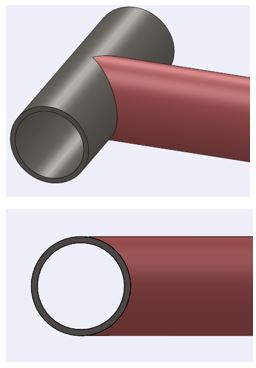
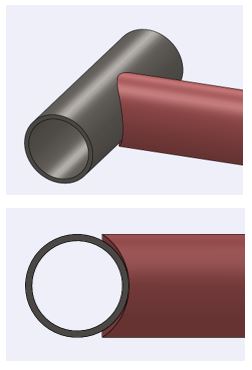
The fit-up profile matches your model. The difference is through the wall: the laser leaves the edge perpendicular to the surface instead of carrying the joint angle through the thickness. On a welded cope that is usually the goal, because the square edge sets a consistent land and gap for a full-strength weld.
Example 2: 2 in Square Tube, 3/16 in Wall
A shallow miter, the kind you would draw to a knife point. This is where the difference between a saw and a laser shows up most.
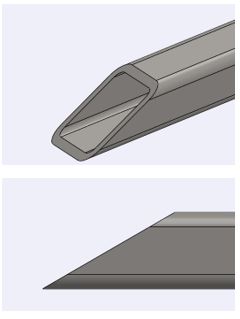
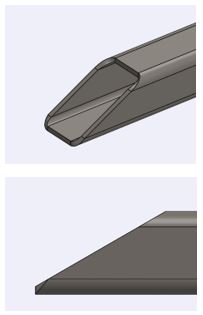
A saw blade passes through the whole section on one plane, so a shallow miter comes to a knife edge. The tube laser cuts each face perpendicular to that face, so at a shallow angle the point is blunted by roughly the wall thickness. The steeper the miter, the more the two agree; the shallower the miter, the more the laser cut differs from the saw cut. If the drawing depends on that knife edge or a matched weld bevel, note it on the part so it is in the quote.
What This Means for Your Drawing
- Copes and miters. The in-plane profile matches your model with tight repeatability. The edge through the wall comes out square to the surface unless you ask for otherwise.
- Bevels and weld prep are available, and quoted separately. The tube laser can cut a weld bevel: we do it to hold identical prep across a run of full-penetration pipe welds. Compound bevels on formed or large parts run on our Prima Optimo 5-axis laser, and heavy plate weld prep comes off the flat laser. None of these are in a standard tube quote by default.
- Call out what the part depends on. If a bevel, knife edge, or specific land matters to the joint, put it on the model or drawing. Then it is priced from the start instead of found at the weld bench.
Send your tube files or CAD model with the tube laser cutting team and we will flag any spot where the cut geometry needs a second look before it runs.